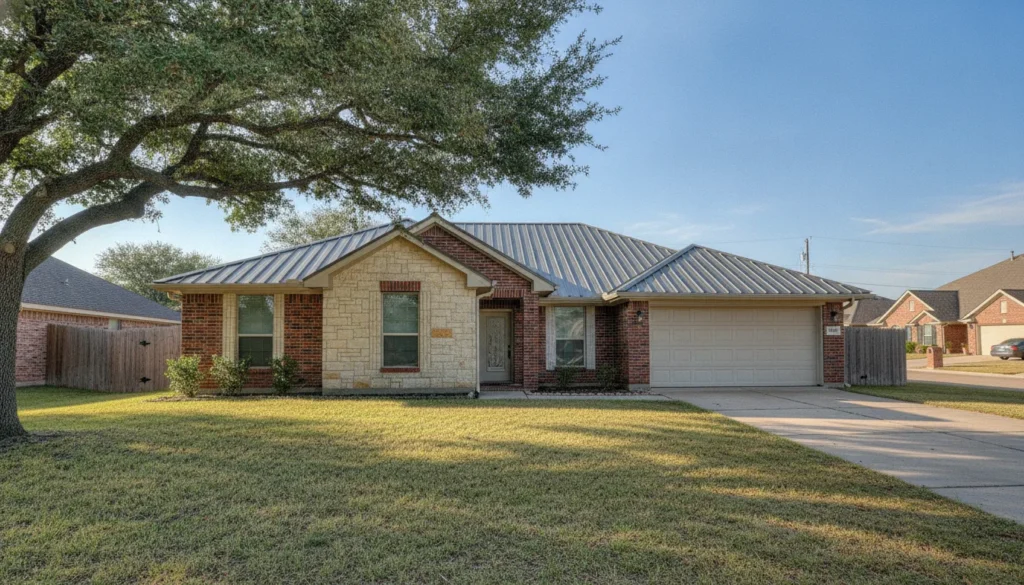
Standing seam is the premium residential metal system in Dallas: concealed fasteners, clean vertical lines, and panels that expand and contract without loosening, which is the failure mode that ages exposed-fastener systems.
Standing seam is defined by what you cannot see. Concealed fasteners mean no exposed screws to back out or gasket-fail under DFW thermal cycling, and the panels float on clips as temperatures swing. The look suits both modern and traditional Dallas architecture. It costs more than exposed-fastener metal and repays that in service life and lower maintenance.
We install and service standing seam metal roofing across Dallas, and every project begins with a free written estimate and an inspection documented with photos. We never waive deductibles, which Texas law prohibits, and we do not act as a public adjuster.
Standing seam on a Dallas roofline
Dallas housing splits into two groups for this system. The 14 percent of homes built in 2010 or later tend to have newer decking under the old roof, while the 48 percent built before 1980 often need deck repairs first. Either way, we check the deck before the panels are ordered, because clips are only as solid as what they fasten to.
Concealed fasteners matter in a hail market. Dallas has seen one-inch or larger hail on 77 days since 2006 within 13 miles of the city, and the 4.25-inch stones of May 24, 2011 remain the Dallas County benchmark. With no exposed screws, a storm leaves fewer places for water to find. Highland Park and University Park get the same crews and the same clip details.
THE SYSTEM
Standing Seam Metal Roofing, up close.
Standing seam metal. Wide flat pans, concealed fasteners: the profile that shrugs off hail seasons.
PUBLIC RECORD
The local record behind Standing Seam Metal Roofing in Dallas
How a roof system holds up in Dallas depends on the storms it has to take and the houses it sits on. Here is what the public record shows.
77
Hail days, 1 in.+ since 2006
25
Golf-ball-size hail days
4.25 in.
Largest stone on record
1981
Median year homes built
Hail near Dallas
Hail is a regular event around Dallas. NOAA's Storm Events Database lists 77 separate days since 2006 with hail one inch or larger reported within 13 miles of the city, and on 25 of those days the stones reached golf ball size or bigger. Hail that size was reported in 20 of the last 20 years. The largest stones on record nearby measured 4.25 inches (grapefruit size) on May 24, 2011. The most recent report: 1.5-inch hail on June 2, 2026.
May 24, 2011: 4.25-inch hail (grapefruit size)
April 25, 2026: 3-inch hail (teacup size)
June 6, 2018: 3-inch hail (teacup size)
June 13, 2012: 3-inch hail (teacup size)
April 3, 2012: 2.75-inch hail (baseball size)
How old Dallas homes are
The median home in Dallas was built in 1981, and 48% of the city's 590,237 housing units predate 1980. Many of these houses are likely on their second roof or nearing the point where they need one.
Sources: NOAA National Centers for Environmental Information, Storm Events Database (hail reports since 2006 within 13 miles of Dallas); U.S. Census Bureau, American Community Survey 2020–2024 5-year estimates. Data pulled September 2026.
Common questions about standing seam metal roofing in Dallas
What is the difference between standing seam and regular metal roofing in Dallas?
Fasteners. Standing seam conceals them under raised seams so panels can move with temperature swings; exposed-fastener systems like R-panel screw through the panel face, and those screw points become the maintenance schedule.
How long does standing seam last in Dallas?
Decades beyond asphalt. Typically forty to sixty years with quality coatings, and DFW hail that would total a shingle roof usually leaves standing seam functional.
Does this material suit older Dallas homes?
Often, with eyes open: older decks get inspected board by board before any system goes down, and weight or structural questions get answered before quoting. The material conversation starts with what your specific roof can carry.
How often does hail hit Dallas?
NOAA's Storm Events Database lists 77 days since 2006 with hail one inch or larger reported within 13 miles of Dallas, including 25 days with golf ball size stones or bigger. Hail that size was reported in 20 of the last 20 years. The most recent report was 1.5-inch hail on June 2, 2026.
How old are most homes in Dallas?
The median home in Dallas was built in 1981, according to the U.S. Census Bureau's American Community Survey. 48% of the city's housing units predate 1980 and 14% were built in 2010 or later. Most homes here are well past the life of their original roof.