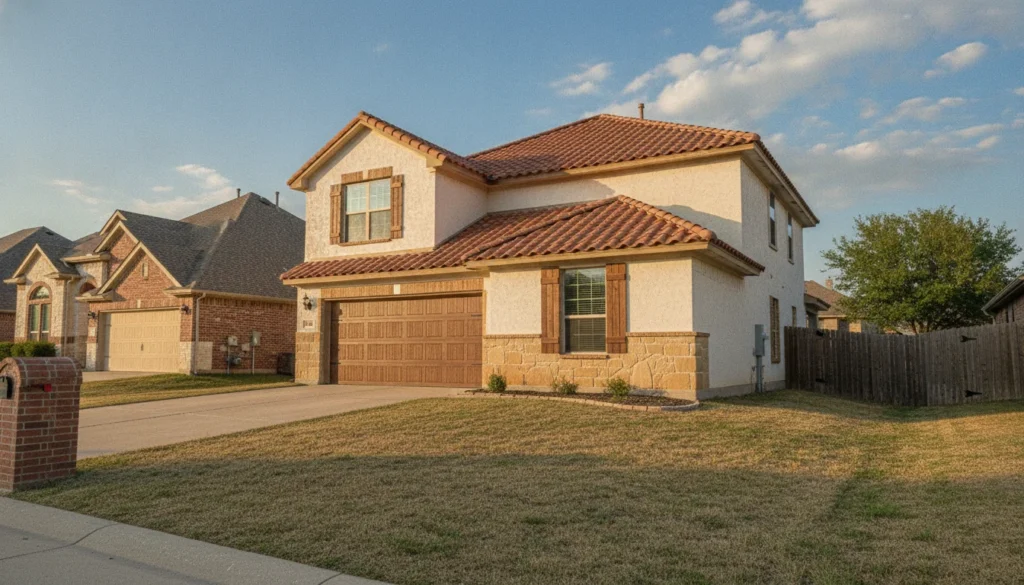
Clay and concrete tile give Fort Worth homes a roof that shrugs off UV and defines Mediterranean and Spanish architecture, with structural weight requirements that make installer experience non-negotiable.
Tile’s strengths are longevity and indifference to sun; its demands are weight and detail. A tile roof can outlast several shingle cycles, but the structure has to carry it, the underlayment beneath has its own service life, and walking it wrong breaks tiles. On re-tile projects, the underlayment, not the tile, is usually what actually failed.
We start every Fort Worth tile job with a photo-documented inspection and a free written estimate. We will not waive a deductible, which Texas law prohibits, and we are not a public adjuster.
Re-Tile and New Tile Across Fort Worth
Fort Worth’s older tile roofs are where underlayment questions come up most. With 34 percent of homes built before 1980 and a median build year of 1994, many tile roofs here are old enough that the tile still looks fine while the layer beneath it has worn out. That is a job for an installer who knows where to look.
Hail adds a reason to inspect. Fort Worth has seen hail an inch or larger in 20 of the last 20 years within 14 miles, and 36 of those storm days since 2006 brought golf ball size or bigger. We check tiles for cracks from the attic side as well as the surface. Our crews cover Tarrant County, including Blue Mound and Westworth Village.
THE SYSTEM
Tile Roofing, up close.
Clay tile. S-profile courses with proper headlap and mortared caps, good for decades of Texas service.
PUBLIC RECORD
The local record behind Tile Roofing in Fort Worth
How a roof system holds up in Fort Worth depends on the storms it has to take and the houses it sits on. Here is what the public record shows.
98
Hail days, 1 in.+ since 2006
36
Golf-ball-size hail days
4.25 in.
Largest stone on record
1994
Median year homes built
Hail near Fort Worth
Hail is a regular event around Fort Worth. NOAA's Storm Events Database lists 98 separate days since 2006 with hail one inch or larger reported within 14 miles of the city, and on 36 of those days the stones reached golf ball size or bigger. Hail that size was reported in 20 of the last 20 years. The largest stones on record nearby measured 4.25 inches (grapefruit size) on May 24, 2011. The most recent report: 1-inch hail on May 25, 2026.
May 24, 2011: 4.25-inch hail (grapefruit size)
June 1, 2025: 3-inch hail (teacup size)
March 16, 2023: 3-inch hail (teacup size)
April 28, 2021: 3-inch hail (teacup size)
March 24, 2021: 3-inch hail (teacup size)
How old Fort Worth homes are
The median home in Fort Worth was built in 1994, and 34% of the city's 373,948 housing units predate 1980. Many of these houses are likely on their second roof or nearing the point where they need one.
Sources: NOAA National Centers for Environmental Information, Storm Events Database (hail reports since 2006 within 14 miles of Fort Worth); U.S. Census Bureau, American Community Survey 2020–2024 5-year estimates. Data pulled September 2026.
Common questions about tile roofing in Fort Worth
How long does a tile roof last in Fort Worth?
The tile itself can serve fifty-plus years; the underlayment beneath typically needs renewal decades sooner. Many "failed" tile roofs are underlayment failures wearing a tile disguise.
Can hail break roof tiles?
Large hail can crack tile, and DFW is honest hail country. Cracked tiles are individually replaceable, which is part of tile's long-life logic; keeping attic spares from your original lot is smart.
Does this material suit older Fort Worth homes?
Often, with eyes open: older decks get inspected board by board before any system goes down, and weight or structural questions get answered before quoting. The material conversation starts with what your specific roof can carry.
How often does hail hit Fort Worth?
NOAA's Storm Events Database lists 98 days since 2006 with hail one inch or larger reported within 14 miles of Fort Worth, including 36 days with golf ball size stones or bigger. Hail that size was reported in 20 of the last 20 years. The most recent report was 1-inch hail on May 25, 2026.
How old are most homes in Fort Worth?
The median home in Fort Worth was built in 1994, according to the U.S. Census Bureau's American Community Survey. 34% of the city's housing units predate 1980 and 23% were built in 2010 or later. Many homes here are reaching the age when original roofs come due.