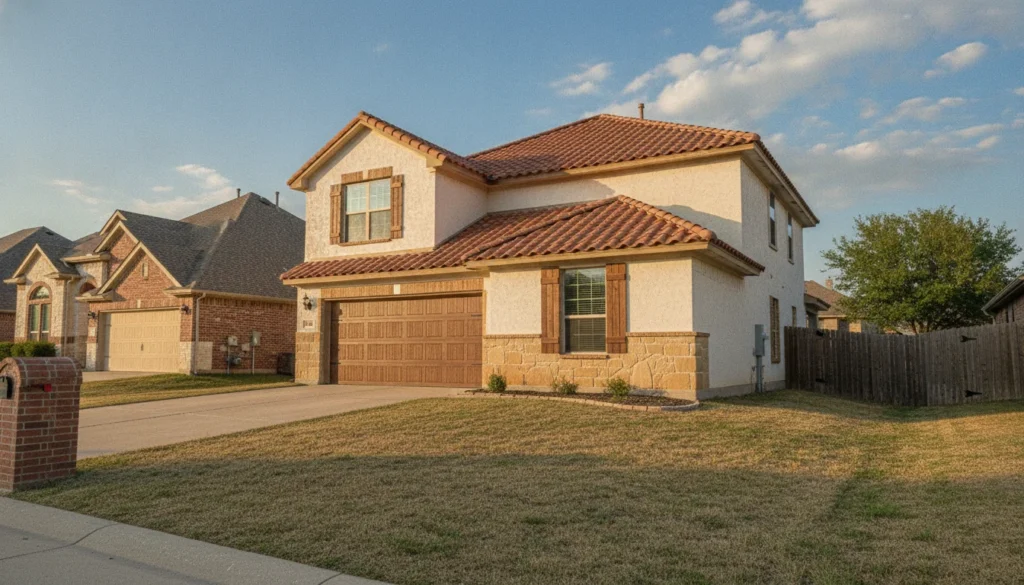
Concrete tile delivers tile aesthetics and longevity at a friendlier price than clay, the pragmatic tile choice for most Fort Worth homes designed to carry it.
Concrete tile resists impact better than clay, comes in profiles that imitate barrel tile, slate, and shake, and costs meaningfully less. Weight is its design limit: it is the heaviest common residential roofing and needs a structure rated to carry it. Where the framing checks out, concrete tile delivers strong value per decade on a Fort Worth home.
We confirm that fit with an inspection documented in photos and a free written estimate. If a claim is involved, we never waive the deductible, since Texas law forbids it, and we are not a public adjuster.
Is Your Fort Worth Framing Ready for Concrete Tile?
Structure is the deciding question. Fort Worth’s homes have a median year built of 1994, with 43 percent built from 1980 to 2009 and 23 percent from 2010 on. Many were framed for lighter materials, so verifying the load comes before any talk of profile or color.
Hail is the other factor. Big cores can crack concrete tile, and Fort Worth sees them: 36 days of golf-ball-or-larger hail within 14 miles since 2006, plus the 4.25-inch record from May 24, 2011. That is why our post-storm checks cover the attic side along with the surface. Tarrant County crews serving Fort Worth also cover Sansom Park and River Oaks.
THE SYSTEM
Concrete Tile Roofing, up close.
Clay tile. S-profile courses with proper headlap and mortared caps, good for decades of Texas service.
PUBLIC RECORD
The local record behind Concrete Tile Roofing in Fort Worth
How a roof system holds up in Fort Worth depends on the storms it has to take and the houses it sits on. Here is what the public record shows.
98
Hail days, 1 in.+ since 2006
36
Golf-ball-size hail days
4.25 in.
Largest stone on record
1994
Median year homes built
Hail near Fort Worth
Hail is a regular event around Fort Worth. NOAA's Storm Events Database lists 98 separate days since 2006 with hail one inch or larger reported within 14 miles of the city, and on 36 of those days the stones reached golf ball size or bigger. Hail that size was reported in 20 of the last 20 years. The largest stones on record nearby measured 4.25 inches (grapefruit size) on May 24, 2011. The most recent report: 1-inch hail on May 25, 2026.
May 24, 2011: 4.25-inch hail (grapefruit size)
June 1, 2025: 3-inch hail (teacup size)
March 16, 2023: 3-inch hail (teacup size)
April 28, 2021: 3-inch hail (teacup size)
March 24, 2021: 3-inch hail (teacup size)
How old Fort Worth homes are
The median home in Fort Worth was built in 1994, and 34% of the city's 373,948 housing units predate 1980. Many of these houses are likely on their second roof or nearing the point where they need one.
Sources: NOAA National Centers for Environmental Information, Storm Events Database (hail reports since 2006 within 14 miles of Fort Worth); U.S. Census Bureau, American Community Survey 2020–2024 5-year estimates. Data pulled September 2026.
Common questions about concrete tile roofing in Fort Worth
Is concrete tile too heavy for my Fort Worth house?
That is a structural question with a real answer. Homes designed for tile carry it fine; converting a shingle-framed home to tile requires an engineering check first. We do not skip that step.
Does concrete tile fade?
Surface color mellows over the decades, and most owners consider aged concrete tile handsome. Unlike coatings on metal or asphalt, there is no film to peel; the color change is gradual and even.
Does this material suit older Fort Worth homes?
Often, with eyes open: older decks get inspected board by board before any system goes down, and weight or structural questions get answered before quoting. The material conversation starts with what your specific roof can carry.
How often does hail hit Fort Worth?
NOAA's Storm Events Database lists 98 days since 2006 with hail one inch or larger reported within 14 miles of Fort Worth, including 36 days with golf ball size stones or bigger. Hail that size was reported in 20 of the last 20 years. The most recent report was 1-inch hail on May 25, 2026.
How old are most homes in Fort Worth?
The median home in Fort Worth was built in 1994, according to the U.S. Census Bureau's American Community Survey. 34% of the city's housing units predate 1980 and 23% were built in 2010 or later. Many homes here are reaching the age when original roofs come due.