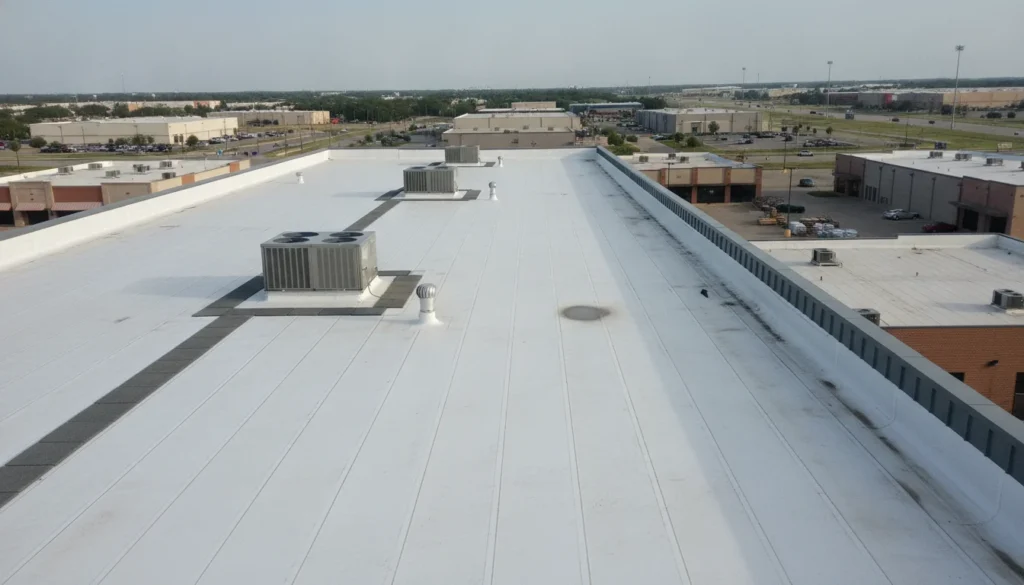
Kitchen exhaust wears out most membranes. PVC is formulated to resist the oils and fats that break down TPO and EPDM around vents, and it pairs that with heat-welded seams, strong reflectivity, and chemical resistance. That makes it the specification wherever a Fort Worth roof sits downstream of a grease stack: restaurants, groceries, and food processing. Every job starts with a free written estimate and an inspection documented with photos. We never waive a deductible, since Texas law bars it, and we are not a public adjuster.
PVC on Fort Worth restaurant and grocery roofs
A food-service roof in Fort Worth fights on two fronts: grease from the vents and hail from above. The second is a regular visitor. One-inch hail has fallen within 14 miles of the city in 20 of the last 20 years, and 36 days since 2006 brought golf-ball-size hail or larger. A bruised or punctured membrane beside an exhaust fan lets grease and water work in at once, so after storms we check welds and vent flashings first and document them with photos. The city’s building stock spans every era, with a median housing year of 1994 and 43 percent of units built from 1980 to 2009, so we judge each roof on its own condition rather than its age. Tarrant County neighbors in Westworth Village and Blue Mound get the same crews.