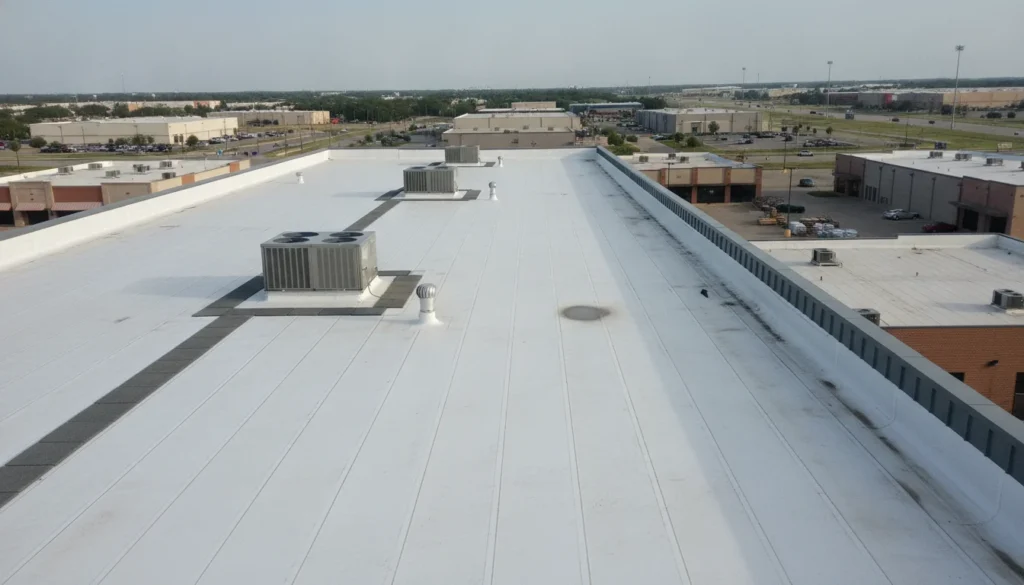
Built-up roofing, or tar and gravel, is the century-old system still protecting Royse City buildings that were roofed before single-ply existed, and still a legitimate choice for the right structure.
BUR builds a roof in redundant layers: alternating bitumen and reinforcing felts topped with gravel that shields the assembly from UV and traffic. Existing BUR in Royse City often earns maintenance and restoration over replacement, since the mass and redundancy that made it heavy also made it durable.
We install and service built-up roofing (bur) across Royse City and the surrounding DFW communities. That includes free written estimates, documented inspections, and honest guidance on whether this system actually fits your home and budget.
On the ground in Royse City
What Built-Up Roofing (BUR) costs and returns in Royse City depends on the houses it goes onto. Most of the housing went up in the last two decades, which means first-generation roofs aging out on the same schedule, block after block. That inventory rewards the boring commercial virtues: documented seams, maintained drains, and a membrane matched to the building’s actual use.
The permit runs through Royse City’s building department; we handle the filing and the inspection scheduling as part of the job. When the next core drops through Rockwall County, single-ply shows bruise fractures that a chalk circle will not catch. Instrument surveys find what walking the roof misses. Because Rockwall, Fate, and Heath share our dispatch routes, examples of this exact system nearby are easy to arrange. We put the whole thing in writing (findings, grade, price, warranty) before you commit to anything.
THE SYSTEM
Built-Up Roofing (BUR), up close.
Flat / low-slope membrane. Single-ply and built-up systems chosen by what the roof actually does all day.
PUBLIC RECORD
The local record behind Built-Up Roofing (BUR) in Royse City
How a roof system holds up in Royse City depends on the storms it has to take and the houses it sits on. Here is what the public record shows.
9
Hail days, 1 in.+ since 2006
3
Golf-ball-size hail days
2.75 in.
Largest stone on record
2010
Median year homes built
Hail near Royse City
Reported hail is less frequent around Royse City: NOAA lists 9 days since 2006 with hail one inch or larger within 6 miles. Fewer reports can also reflect fewer storm spotters in smaller communities, so a quiet record is not a guarantee. Hail that size was reported in 8 of the last 20 years. The largest stones on record nearby measured 2.75 inches (baseball size) on April 27, 2026.
April 27, 2026: 2.75-inch hail (baseball size)
June 11, 2023: 2.75-inch hail (baseball size)
April 11, 2016: 2-inch hail (hen egg size)
April 23, 2021: 1.5-inch hail (walnut size)
August 30, 2019: 1.25-inch hail (half dollar size)
How old Royse City homes are
Royse City is young by roofing standards: the median home was built in 2010, and 49% of its 7,146 housing units date to 2010 or later. Many of those homes still have the roof the builder installed, now working through its first hail seasons.
Sources: NOAA National Centers for Environmental Information, Storm Events Database (hail reports since 2006 within 6 miles of Royse City); U.S. Census Bureau, American Community Survey 2020–2024 5-year estimates. Data pulled September 2026.
Common questions about built-up roofing (bur) in Royse City
My Royse City building has tar-and-gravel. Replace it?
Not automatically. Sound BUR restores and maintains well; its redundancy is real. A moisture survey tells you whether the assembly beneath the gravel is dry, and that answer decides.
Why did BUR fall out of fashion?
Weight, installation labor, and odor during application. Single-ply installs faster and lighter. Neither of those points makes an existing sound BUR roof bad.
Is upgrading from builder-grade shingles worth it in Royse City?
Usually at the first replacement or claim: Class 4 impact-rated systems earn many Texas carriers' premium discounts, and newer communities' HOA standards generally approve them easily. The math works hardest on homes facing decades of DFW hail.
How often does hail hit Royse City?
NOAA lists 9 days since 2006 with hail one inch or larger within 6 miles of Royse City. Smaller communities have fewer storm spotters, so reports tend to undercount what actually falls. The most recent report was 2.75-inch hail on April 27, 2026.
How old are most homes in Royse City?
The median home in Royse City was built in 2010, according to the U.S. Census Bureau's American Community Survey. 8% of the city's housing units predate 1980 and 49% were built in 2010 or later. Many homes here still have their original builder-installed roof.