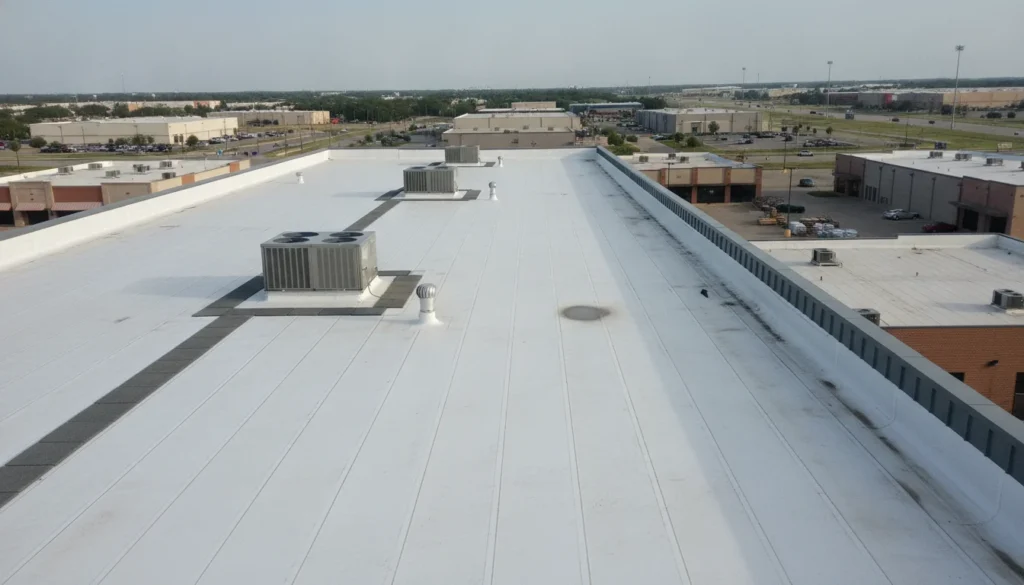
PVC is the membrane that shrugs off grease and chemicals, which is why Seagoville restaurants and food-service buildings specify it over everything else.
Kitchen exhaust is brutal to most membranes; PVC is formulated to resist the oils and fats that degrade TPO and EPDM around vents. Heat-welded seams, strong reflectivity, and chemical resistance make PVC the specification wherever a Seagoville roof lives downstream of a grease stack: restaurants, groceries, food processing.
We install and service pvc roofing across Seagoville and the surrounding DFW communities. Expect free written estimates, documented inspections, and honest guidance on whether this system actually fits your home and budget.
The local case in Seagoville
Every city wears this system a little differently, and Seagoville is no exception. The neighborhoods skew established: multiple roof generations behind them, big tree canopies overhead, and original decking that deserves inspection before anything new goes on. That building stock puts membranes to work: seams, penetrations, and drainage patterns matter more than brand names, and the moisture survey decides restore-versus-replace.
Like the rest of Dallas County, Seagoville wants roofing work documented: permits where required, inspections passed. That paperwork is included, not extra. North Texas sits in the country’s most active hail belt, and single-ply shows bruise fractures that a chalk circle will not catch. Instrument surveys find what walking the roof misses. The same crews run Dallas, Irving, and Garland, so comparable local installs are usually close enough to go look at. When we quote it, ask for nearby addresses. A real roof with weather on it is the honest brochure.
THE SYSTEM
PVC Roofing, up close.
PVC membrane. Welded single-ply built for chemical and grease resistance on demanding roofs.
PUBLIC RECORD
The local record behind PVC Roofing in Seagoville
How a roof system holds up in Seagoville depends on the storms it has to take and the houses it sits on. Here is what the public record shows.
7
Hail days, 1 in.+ since 2006
1
Golf-ball-size hail days
1.75 in.
Largest stone on record
1992
Median year homes built
Hail near Seagoville
Reported hail is less frequent around Seagoville: NOAA lists 7 days since 2006 with hail one inch or larger within 5 miles. Fewer reports can also reflect fewer storm spotters in smaller communities, so a quiet record is not a guarantee. Hail that size was reported in 4 of the last 20 years. The largest stones on record nearby measured 1.75 inches (golf ball size) on May 17, 2010. The most recent report: 1.5-inch hail on June 2, 2026.
May 17, 2010: 1.75-inch hail (golf ball size)
June 2, 2026: 1.5-inch hail (walnut size)
April 3, 2012: 1.5-inch hail (walnut size)
May 10, 2021: 1-inch hail (quarter size)
March 24, 2021: 1-inch hail (quarter size)
How old Seagoville homes are
The median home in Seagoville was built in 1992, and 36% of the city's 5,692 housing units predate 1980. Many of these houses are likely on their second roof or nearing the point where they need one.
Sources: NOAA National Centers for Environmental Information, Storm Events Database (hail reports since 2006 within 5 miles of Seagoville); U.S. Census Bureau, American Community Survey 2020–2024 5-year estimates. Data pulled September 2026.
Common questions about pvc roofing in Seagoville
Why does my restaurant roof in Seagoville need PVC specifically?
Grease resistance. Kitchen exhaust deposits oils that degrade other membranes around the vents. PVC is formulated for that exposure, which is why food-service specifications call for it.
Is PVC worth it on a non-restaurant building?
Sometimes. Its chemical resistance and seam strength are real. Without grease or chemical exposure, TPO usually delivers similar performance at friendlier cost.
Should we match the original material when re-roofing in Seagoville?
Not automatically. A roof on its second or third cycle is a chance to rethink: Class 4 asphalt for the insurance math, metal or premium systems where the home and horizon justify them. We quote the honest options against your actual house.
How often does hail hit Seagoville?
NOAA lists 7 days since 2006 with hail one inch or larger within 5 miles of Seagoville. Smaller communities have fewer storm spotters, so reports tend to undercount what actually falls. The most recent report was 1.5-inch hail on June 2, 2026.
How old are most homes in Seagoville?
The median home in Seagoville was built in 1992, according to the U.S. Census Bureau's American Community Survey. 36% of the city's housing units predate 1980 and 18% were built in 2010 or later. Many homes here are reaching the age when original roofs come due.