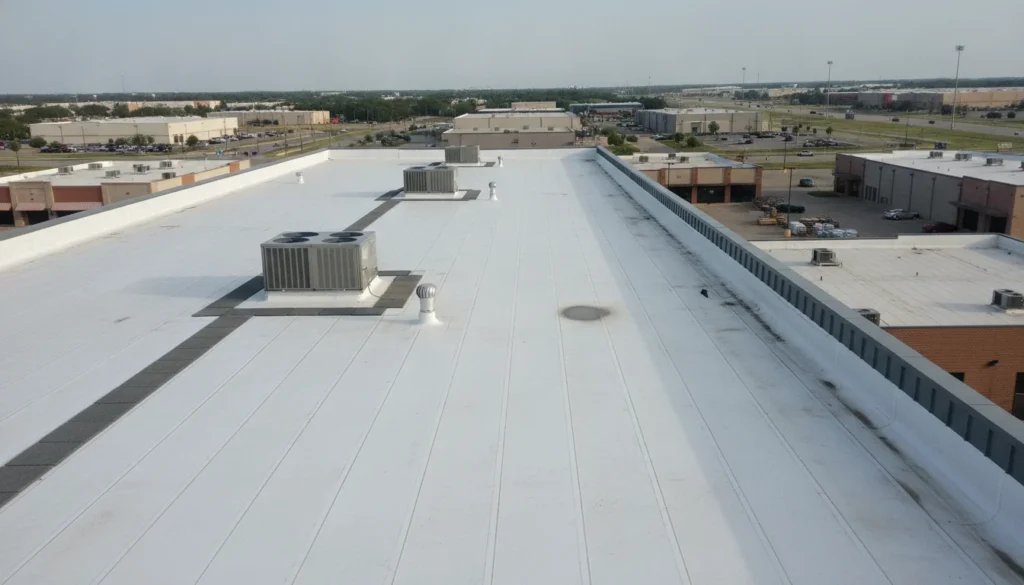
TPO is the dominant single-ply membrane on Palmer commercial roofs. It is white, reflective, heat-welded at the seams, and the economic default for most new low-slope work.
TPO earned its market share honestly: reflective white surface that fights Texas cooling loads, heat-welded seams stronger than the sheet itself when done right, and installed economics that beat most alternatives. The membrane’s reputation variance in Palmer is mostly a workmanship story. Seam quality is everything, which makes installer selection the real specification.
We install and service tpo roofing across Palmer and the surrounding DFW communities. You get free written estimates, documented inspections, and honest guidance on whether this system actually fits your building and budget.
Palmer Commercial Roof Materials and a Lighter Hail Record
Palmer’s hail record, with no tennis-ball size or larger reports since 2006 and a peak of 2.0 inches, makes impact resistance one factor among several rather than the deciding one when owners compare single-ply sheets, modified bitumen, built-up layers, coatings and metal panels. Drainage, maintenance access and the condition of the existing deck often matter as much. Since hail one inch or larger has come in only 4 of the last 20 years, a routine inspection schedule tends to do more for a Palmer roof than storm-driven checks alone, though a look after any hail event is still worthwhile.
THE SYSTEM
TPO Roofing, up close.
TPO membrane. White single-ply with heat-welded seams and flashed curbs, managed as a system.
PUBLIC RECORD
The local record behind TPO Roofing in Palmer
How a roof system holds up in Palmer depends on the storms it has to take and the houses it sits on. Here is what the public record shows.
6
Hail days, 1 in.+ since 2006
2
Golf-ball-size hail days
2 in.
Largest stone on record
1989
Median year homes built
Hail near Palmer
Reported hail is less frequent around Palmer: NOAA lists 6 days since 2006 with hail one inch or larger within 4 miles. Fewer reports can also reflect fewer storm spotters in smaller communities, so a quiet record is not a guarantee. Hail one inch or larger was reported in 4 of the last 20 years. The largest stones on record nearby measured 2 inches (hen egg size) on May 27, 2024.
May 27, 2024: 2-inch hail (hen egg size)
April 26, 2011: 1.75-inch hail (golf ball size)
June 9, 2019: 1.5-inch hail (walnut size)
May 17, 2010: 1.5-inch hail (walnut size)
October 23, 2011: 1-inch hail (quarter size)
How old Palmer homes are
The median home in Palmer was built in 1989, and 33% of the city's 848 housing units predate 1980. Many of these houses are likely on their second roof or nearing the point where they need one.
Sources: NOAA National Centers for Environmental Information, Storm Events Database (hail reports since 2006 within 4 miles of Palmer); U.S. Census Bureau, American Community Survey 2020–2024 5-year estimates. Data pulled September 2026.
Common questions about tpo roofing in Palmer
Why is TPO so common on Palmer commercial buildings?
Economics plus reflectivity: white TPO reflects Texas sun and cuts cooling loads, and installed cost per square beats most alternatives. Seam workmanship separates good TPO roofs from problem ones.
What thickness TPO should I specify?
Sixty-mil is the common commercial baseline; forty-five suits budget-driven jobs and eighty adds puncture margin under heavy rooftop traffic. Thickness buys durability, so match it to the building's use.
Do you install this on shops and outbuildings near Palmer?
Yes. Barns, workshops, and outbuildings are first-class projects out here, not afterthoughts, and the material conversation (usually metal-forward) covers them alongside the house.
How often does hail hit Palmer?
NOAA lists 6 days since 2006 with hail one inch or larger within 4 miles of Palmer. Smaller communities have fewer storm spotters, so reports tend to undercount what actually falls. The most recent report was 2-inch hail on May 27, 2024.
How old are most homes in Palmer?
The median home in Palmer was built in 1989, according to the U.S. Census Bureau's American Community Survey. 33% of the city's housing units predate 1980 and 31% were built in 2010 or later. Many homes here are reaching the age when original roofs come due.