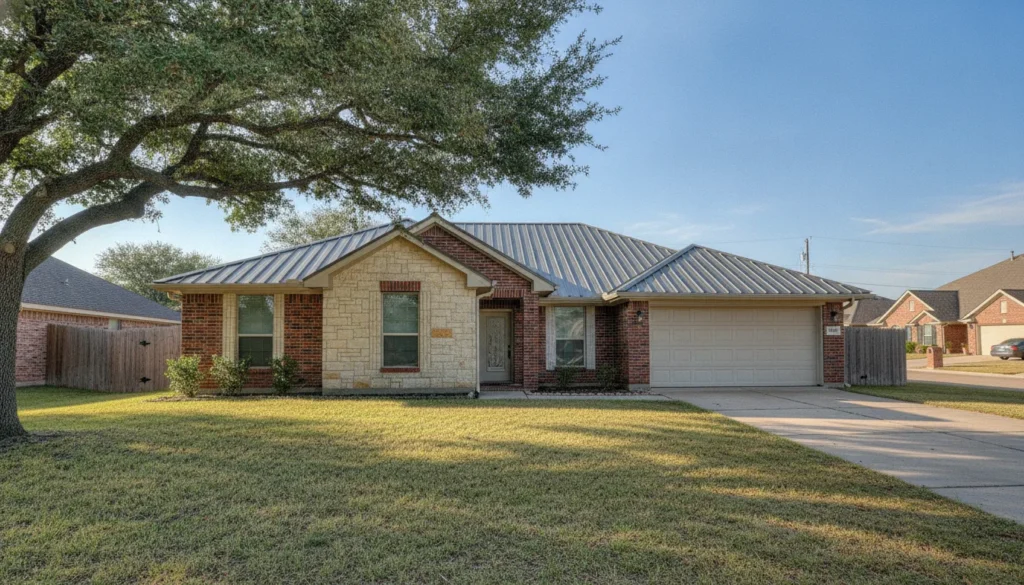
Metal roofing in Lake Worth trades a higher upfront cost for decades of additional service life, stronger wind performance, and hail resilience that matters in North Texas.
The metal family runs wider than most Lake Worth homeowners expect: standing seam with concealed fasteners at the premium end, the R-panel systems Texas has trusted for generations, stone-coated steel that reads like tile from the street, plus copper, aluminum, and galvalume options. Each has its own guide. The honest summary is that metal costs more on day one and less per year of service life, and its hail story is about dents versus punctures: cosmetic denting can happen, but the weather seal usually survives impacts that would total a shingle roof.
We install and service metal roofing across Lake Worth and the surrounding DFW communities: free written estimates, documented inspections, and honest guidance on whether this system actually fits your home and budget.
What is different in Lake Worth
Metal Roofing behaves differently on Lake Worth roofs than the brochure version suggests. Much of the housing here has already been through a roof cycle or two: mature trees, settled framing, and decking that has absorbed decades of North Texas heat. Metal changes the calculation on those houses: a step up in wind rating and service life, with panels that ride out gusts that lift shingle tabs.
Like the rest of Tarrant County, Lake Worth wants roofing work documented, meaning permits where required and inspections passed. That paperwork is included, not extra. Hail is the tax every DFW roof eventually pays; steel takes cosmetic dents and keeps the water out, a trade most metal owners accept happily. Nearby Fort Worth and Arlington see the same crews and the same spec, so the install you would get has local addresses attached. The next step costs nothing: a documented inspection and a straight answer on whether this system fits.
THE SYSTEM
Metal Roofing, up close.
Standing seam metal. Wide flat pans, concealed fasteners: the profile that shrugs off hail seasons.
PUBLIC RECORD
The local record behind Metal Roofing in Lake Worth
How a roof system holds up in Lake Worth depends on the storms it has to take and the houses it sits on. Here is what the public record shows.
16
Hail days, 1 in.+ since 2006
4
Golf-ball-size hail days
3 in.
Largest stone on record
1968
Median year homes built
Hail near Lake Worth
NOAA's Storm Events Database lists 16 days since 2006 with hail one inch or larger reported within 4 miles of Lake Worth. On 4 of those days, the stones were golf ball size or bigger. Hail that size was reported in 9 of the last 20 years. The largest stones on record nearby measured 3 inches (teacup size) on October 10, 2019. The most recent report: 1.25-inch hail on April 25, 2026.
October 10, 2019: 3-inch hail (teacup size)
May 24, 2011: 1.75-inch hail (golf ball size)
April 10, 2011: 1.75-inch hail (golf ball size)
April 17, 2008: 1.75-inch hail (golf ball size)
April 28, 2020: 1.5-inch hail (walnut size)
How old Lake Worth homes are
Half of Lake Worth's 1,960 housing units were built in 1968 or earlier, and 61% predate 1980. On homes that age, today's roof is rarely the original, and older decking, layered repairs and ventilation that was never brought up to date are common.
Sources: NOAA National Centers for Environmental Information, Storm Events Database (hail reports since 2006 within 4 miles of Lake Worth); U.S. Census Bureau, American Community Survey 2020–2024 5-year estimates. Data pulled September 2026.
Common questions about metal roofing in Lake Worth
Is a metal roof loud in the rain in Lake Worth?
Over a solid deck with underlayment, which is how residential metal is installed, the sound difference from shingles is minor. The tin-roof-on-a-barn sound comes from metal over open framing, which is not how homes are roofed.
Does hail ruin metal roofs in Lake Worth?
Hail can cosmetically dent metal, but the weather seal usually survives impacts that would puncture or bruise shingles. Some policies handle cosmetic denting differently, so it's worth asking your carrier about before you buy.
Should we match the original material when re-roofing in Lake Worth?
Not automatically. A roof on its second or third cycle is a chance to rethink: Class 4 asphalt for the insurance math, metal or premium systems where the home and horizon justify them. We quote the honest options against your actual house.
How often does hail hit Lake Worth?
NOAA's Storm Events Database lists 16 days since 2006 with hail one inch or larger reported within 4 miles of Lake Worth, including 4 days with golf ball size stones or bigger. Hail that size was reported in 9 of the last 20 years. The most recent report was 1.25-inch hail on April 25, 2026.
How old are most homes in Lake Worth?
The median home in Lake Worth was built in 1968, according to the U.S. Census Bureau's American Community Survey. 61% of the city's housing units predate 1980 and 12% were built in 2010 or later. Most homes here are well past the life of their original roof.