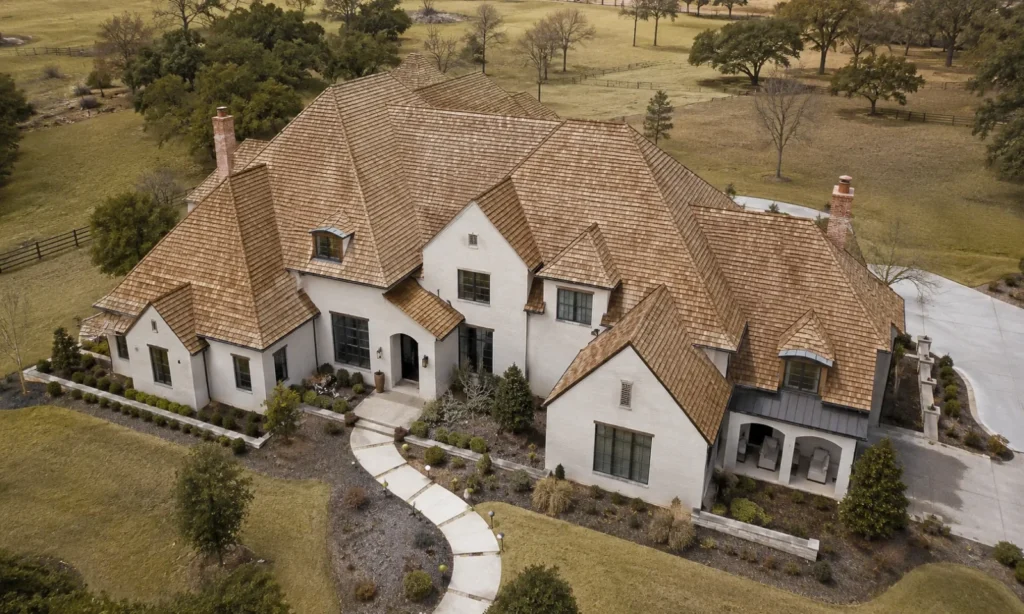
Cedar shake and shingle roofs (what many Richland Hills owners simply call wood roofs) offer a warmth no manufactured product fully matches, with maintenance realities worth walking into open-eyed.
Cedar in Richland Hills is a commitment: it weathers beautifully, insulates naturally, and demands more of both installer and owner than asphalt. Fire treatment matters, ventilation matters doubly, and DFW hail is harder on wood than on Class 4 composites. For owners who love the material, nothing substitutes; for those drawn to the look alone, the synthetic shake guide is honest about the alternative.
We install and service cedar roofing across Richland Hills and the surrounding DFW communities. You get free written estimates, documented inspections, and honest guidance on whether this system actually fits your home and budget.
On the ground in Richland Hills
In Richland Hills, the Cedar Roofing conversation usually starts with the roof that is already up there. Much of the housing here has already been through a roof cycle or two: mature trees, settled framing, and decking that has absorbed decades of North Texas heat. That stock wears cedar handsomely when it is maintained and expensively when it is not; the difference is a treatment cycle most owners have never been told about.
The permit runs through Richland Hills’s building department; we handle the filing and the inspection scheduling as part of the job. North Texas sits in the country’s most active hail belt, and shakes split on impact and every carrier knows it. That makes documentation before and after storms a cedar owner’s best friend. Because Fort Worth, Arlington, and Mansfield share our dispatch routes, examples of this exact system nearby are easy to arrange. Everything above gets specific once we have looked at the actual roof, and it comes in writing.
THE SYSTEM
Cedar Roofing, up close.
Cedar shake. Hand-split shakes across a complex roofline, with character that earns its maintenance.
PUBLIC RECORD
The local record behind Cedar Roofing in Richland Hills
How a roof system holds up in Richland Hills depends on the storms it has to take and the houses it sits on. Here is what the public record shows.
16
Hail days, 1 in.+ since 2006
4
Golf-ball-size hail days
2.75 in.
Largest stone on record
1959
Median year homes built
Hail near Richland Hills
NOAA's Storm Events Database lists 16 days since 2006 with hail one inch or larger reported within 4 miles of Richland Hills. On 4 of those days, the stones were golf ball size or bigger. Hail that size was reported in 10 of the last 20 years. The largest stones on record nearby measured 2.75 inches (baseball size) on May 27, 2024. The most recent report: 1-inch hail on May 25, 2026.
May 27, 2024: 2.75-inch hail (baseball size)
March 30, 2025: 1.75-inch hail (golf ball size)
April 2, 2023: 1.75-inch hail (golf ball size)
December 27, 2015: 1.75-inch hail (golf ball size)
April 28, 2020: 1.5-inch hail (walnut size)
How old Richland Hills homes are
Half of Richland Hills's 3,420 housing units were built in 1959 or earlier, and 77% predate 1980. On homes that age, today's roof is rarely the original, and older decking, layered repairs and ventilation that was never brought up to date are common.
Sources: NOAA National Centers for Environmental Information, Storm Events Database (hail reports since 2006 within 4 miles of Richland Hills); U.S. Census Bureau, American Community Survey 2020–2024 5-year estimates. Data pulled September 2026.
Common questions about cedar roofing in Richland Hills
How long does a cedar roof last in Richland Hills?
Well-installed, well-ventilated cedar typically serves twenty to thirty years in North Texas. DFW sun and hail are harder on wood than milder climates. Maintenance quality moves that range meaningfully.
Is cedar allowed under fire codes in Richland Hills?
Fire-treated cedar products meet the ratings most DFW jurisdictions require, while untreated shake generally does not. We confirm your city's specific requirements as part of any cedar project.
Should we match the original material when re-roofing in Richland Hills?
Not automatically. A roof on its second or third cycle is a chance to rethink: Class 4 asphalt for the insurance math, metal or premium systems where the home and horizon justify them. We quote the honest options against your actual house.
How often does hail hit Richland Hills?
NOAA's Storm Events Database lists 16 days since 2006 with hail one inch or larger reported within 4 miles of Richland Hills, including 4 days with golf ball size stones or bigger. Hail that size was reported in 10 of the last 20 years. The most recent report was 1-inch hail on May 25, 2026.
How old are most homes in Richland Hills?
The median home in Richland Hills was built in 1959, according to the U.S. Census Bureau's American Community Survey. 77% of the city's housing units predate 1980 and 3% were built in 2010 or later. Most homes here are well past the life of their original roof.