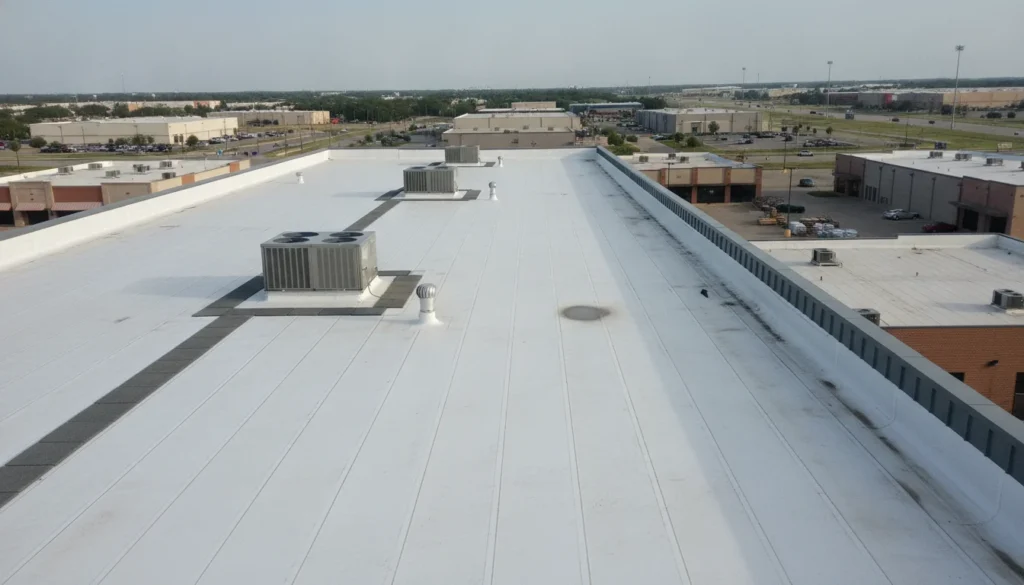
Built-up roofing, or tar and gravel, is the century-old system still protecting Lakeside buildings that were roofed before single-ply existed, and still a legitimate choice for the right structure.
BUR builds a roof in redundant layers: alternating bitumen and reinforcing felts topped with gravel that shields the assembly from UV and traffic. Existing BUR in Lakeside often earns maintenance and restoration over replacement, since the mass and redundancy that made it heavy also made it durable.
We install and service built-up roofing (bur) across Lakeside and the surrounding DFW communities. That includes free written estimates, documented inspections, and honest guidance on whether this system actually fits your home and budget.
Built-Up Roofing (BUR) in Lakeside, specifically
Built-Up Roofing (BUR) behaves differently on Lakeside roofs than the brochure version suggests. Roofs on these streets have been replaced before, leaving layered history, patched decking, and flashing choices from three owners ago. On those buildings, the membrane decision is driven less by material fashion than by what the roof does all day: equipment traffic, ponding zones, and the tenant below.
Permit-wise, this work in Lakeside runs through the city’s building department; filing it is our job, not yours. Hail is the tax every DFW roof eventually pays. Single-ply shows bruise fractures that a chalk circle will not catch, and instrument surveys find what walking the roof misses. Nearby Fort Worth and Arlington see the same crews and the same spec, so the install you would get has local addresses attached. The next step costs nothing: a documented inspection and a straight answer on whether this system fits.
THE SYSTEM
Built-Up Roofing (BUR), up close.
Flat / low-slope membrane. Single-ply and built-up systems chosen by what the roof actually does all day.
PUBLIC RECORD
The local record behind Built-Up Roofing (BUR) in Lakeside
How a roof system holds up in Lakeside depends on the storms it has to take and the houses it sits on. Here is what the public record shows.
0
Hail days, 1 in.+ since 2006
0
Golf-ball-size hail days
–
Largest stone on record
1977
Median year homes built
Hail near Lakeside
NOAA's Storm Events Database lists no hail of one inch or larger within 4 miles of Lakeside since 2006. Reports depend on storm spotters, so smaller communities are under-counted, and nearby cities have recorded significant hail.
How old Lakeside homes are
The median home in Lakeside was built in 1977, and 57% of the city's 215 housing units predate 1980. Many of these houses are likely on their second roof or nearing the point where they need one.
Sources: NOAA National Centers for Environmental Information, Storm Events Database (hail reports since 2006 within 4 miles of Lakeside); U.S. Census Bureau, American Community Survey 2020–2024 5-year estimates. Data pulled September 2026.
Common questions about built-up roofing (bur) in Lakeside
My Lakeside building has tar-and-gravel. Replace it?
Not automatically. Sound BUR restores and maintains well; its redundancy is real. A moisture survey tells you whether the assembly beneath the gravel is dry, and that answer decides.
Why did BUR fall out of fashion?
Weight, installation labor, and odor during application. Single-ply installs faster and lighter. Neither of those points makes an existing sound BUR roof bad.
Should we match the original material when re-roofing in Lakeside?
Not automatically. A roof on its second or third cycle is a chance to rethink: Class 4 asphalt for the insurance math, metal or premium systems where the home and horizon justify them. We quote the honest options against your actual house.
How often does hail hit Lakeside?
NOAA lists no hail reports of an inch or larger within 4 miles of Lakeside since 2006. Reports depend on storm spotters, and neighboring cities have recorded significant hail.
How old are most homes in Lakeside?
The median home in Lakeside was built in 1977, according to the U.S. Census Bureau's American Community Survey. 57% of the city's housing units predate 1980 and 6% were built in 2010 or later. Most homes here are well past the life of their original roof.