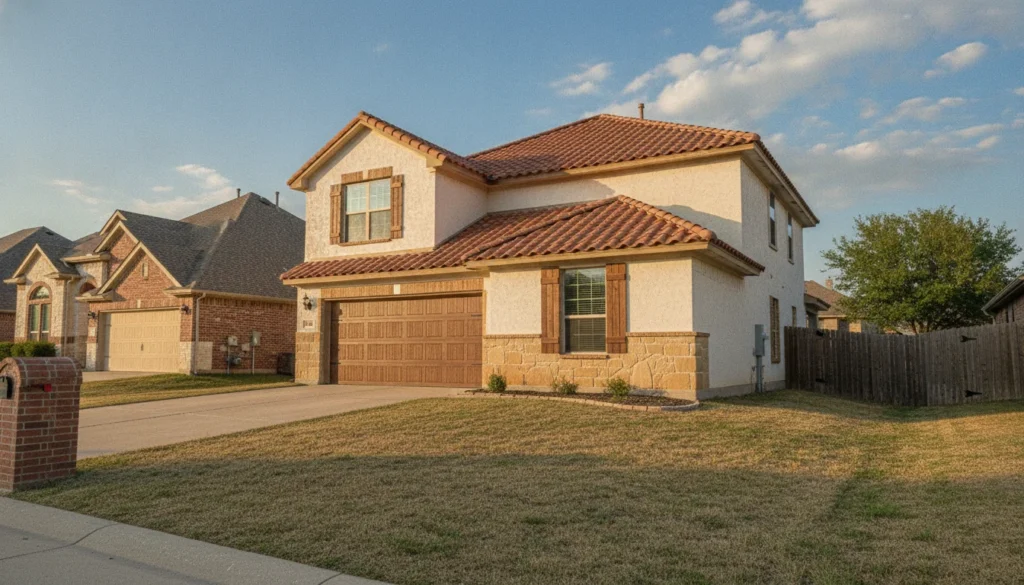
Clay tile is the original: the terracotta barrel and flat profiles that define Spanish and Mediterranean homes in Mabank, fired to a color that never fades.
Clay’s color is the material, not a coating, so a clay roof in Mabank looks the same in year forty as year four. It is lighter than concrete tile but more brittle, costs more, and rewards installers who respect its handling. On architecture built for it, nothing else looks right.
We install and service clay tile roofing across Mabank and the surrounding DFW communities. Expect free written estimates, documented inspections, and honest guidance on whether this system actually fits your home and budget.
The local case in Mabank
In Mabank, the Clay Tile Roofing conversation usually starts with the roof that is already up there. Out here lot sizes stretch and rooflines get more individual; the inventory runs from older farm-town stock to brand-new builds on the same road. For those houses, tile is as much architecture as roofing: it has to suit the elevation, and the framing has to be verified for the weight before anyone talks color.
City paperwork in Mabank is ours to carry: permit filed, inspection booked, final documentation in your folder. North Texas sits in the country’s most active hail belt, and big cores can crack concrete tile, which is why post-storm checks here include the attic side, not just the surface. Because Kaufman, Terrell, and Forney share our dispatch routes, examples of this exact system nearby are easy to arrange. Everything above gets specific, in writing, once we have looked at the actual roof.
THE SYSTEM
Clay Tile Roofing, up close.
Clay tile. S-profile courses with proper headlap and mortared caps, good for decades of Texas service.
PUBLIC RECORD
The local record behind Clay Tile Roofing in Mabank
How a roof system holds up in Mabank depends on the storms it has to take and the houses it sits on. Here is what the public record shows.
7
Hail days, 1 in.+ since 2006
1
Golf-ball-size hail days
1.75 in.
Largest stone on record
2002
Median year homes built
Hail near Mabank
Reported hail is less frequent around Mabank: NOAA lists 7 days since 2006 with hail one inch or larger within 5 miles. Fewer reports can also reflect fewer storm spotters in smaller communities, so a quiet record is not a guarantee. Hail that size was reported in 4 of the last 20 years. The largest stones on record nearby measured 1.75 inches (golf ball size) on April 18, 2015. The most recent report: 1-inch hail on April 29, 2026.
April 18, 2015: 1.75-inch hail (golf ball size)
March 24, 2021: 1.5-inch hail (walnut size)
January 25, 2021: 1.25-inch hail (half dollar size)
May 3, 2017: 1.25-inch hail (half dollar size)
April 29, 2026: 1-inch hail (quarter size)
How old Mabank homes are
The median home in Mabank was built in 2002. A large share of the city's 1,940 housing units are now old enough that original roofs are coming due, while 32% were built in 2010 or later.
Sources: NOAA National Centers for Environmental Information, Storm Events Database (hail reports since 2006 within 5 miles of Mabank); U.S. Census Bureau, American Community Survey 2020–2024 5-year estimates. Data pulled September 2026.
Common questions about clay tile roofing in Mabank
Clay vs concrete tile in Mabank: what is the real difference?
Clay holds color permanently and weighs less but costs more and is more brittle; concrete is tougher and cheaper with color that mellows over decades. Both need structure rated for tile weight.
Is clay tile practical in DFW hail?
Clay can crack in significant hail, though individual tiles replace readily, which is the system's design logic. Owners committed to the look accept occasional tile replacement as part of a fifty-year roof.
Do you install this on shops and outbuildings near Mabank?
Yes. Barns, workshops, and outbuildings are first-class projects out here, not afterthoughts, and the material conversation (usually metal-forward) covers them alongside the house.
How often does hail hit Mabank?
NOAA lists 7 days since 2006 with hail one inch or larger within 5 miles of Mabank. Smaller communities have fewer storm spotters, so reports tend to undercount what actually falls. The most recent report was 1-inch hail on April 29, 2026.
How old are most homes in Mabank?
The median home in Mabank was built in 2002, according to the U.S. Census Bureau's American Community Survey. 27% of the city's housing units predate 1980 and 32% were built in 2010 or later. Many homes here are reaching the age when original roofs come due.