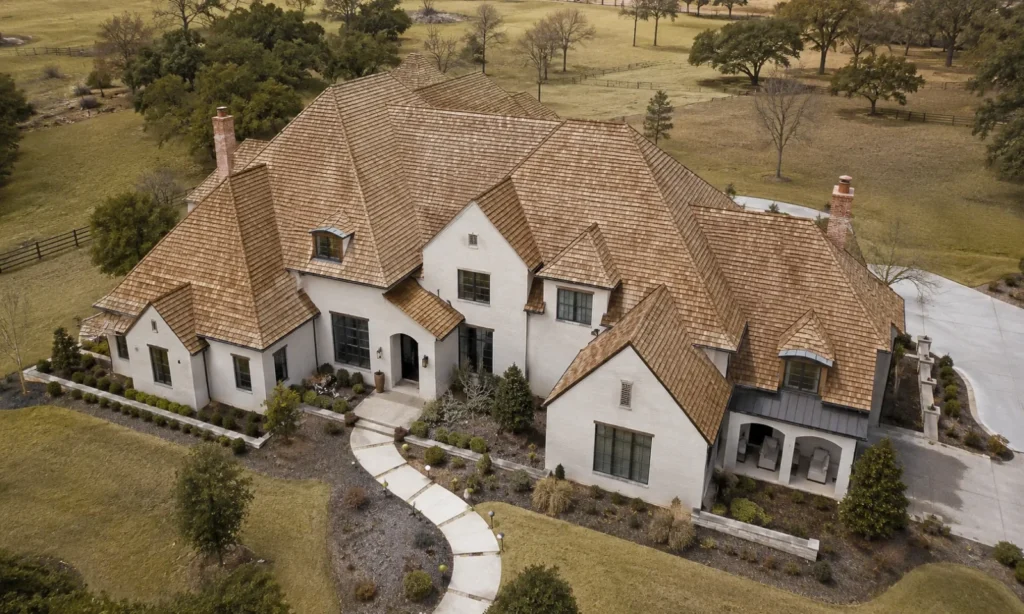
Alaska yellow cedar (also called yellow cedar or Nootka cypress) is the denser, naturally decay-resistant cousin of western red, for Duncanville owners who want cedar's look with more spine.
Yellow cedar’s tighter grain and natural oils resist decay and wear better than red cedar, it silvers to a distinctive even grey, and it costs accordingly. In Duncanville, it suits owners planning to keep a home long enough to collect the durability dividend.
We install and service alaska yellow cedar roofing across Duncanville and the surrounding DFW communities, with free written estimates, documented inspections, and honest guidance on whether this system actually fits your home and budget.
What is different in Duncanville
Alaska Yellow Cedar Roofing behaves differently on Duncanville roofs than the brochure version suggests. Roofs on these streets have been replaced before, which means layered history, patched decking, and flashing choices from three owners ago. Cedar on those houses is a commitment with a maintenance schedule attached; honest owners budget for the care cycle or choose something that does not need one.
Duncanville handles roofing permits the way most Dallas County cities do: required where structure or full replacement is involved, quick when the paperwork is right. We file it. Hail is the tax every DFW roof eventually pays. Shakes split on impact, and every carrier knows it, so documentation before and after storms is a cedar owner’s best friend. The install map around Duncanville includes Dallas and Irving; seeing a five-year-old local roof beats any sample board. The next step costs nothing: a documented inspection and a straight answer on whether this system fits.
THE SYSTEM
Alaska Yellow Cedar Roofing, up close.
Cedar shake. Hand-split shakes across a complex roofline, with character that earns its maintenance.
PUBLIC RECORD
The local record behind Alaska Yellow Cedar Roofing in Duncanville
How a roof system holds up in Duncanville depends on the storms it has to take and the houses it sits on. Here is what the public record shows.
17
Hail days, 1 in.+ since 2006
3
Golf-ball-size hail days
2 in.
Largest stone on record
1978
Median year homes built
Hail near Duncanville
NOAA's Storm Events Database lists 17 days since 2006 with hail one inch or larger reported within 5 miles of Duncanville. On 3 of those days, the stones were golf ball size or bigger. Hail that size was reported in 8 of the last 20 years. The largest stones on record nearby measured 2 inches (hen egg size) on June 12, 2023. The most recent report: 1-inch hail on May 24, 2026.
June 12, 2023: 2-inch hail (hen egg size)
April 9, 2021: 2-inch hail (hen egg size)
June 13, 2012: 2-inch hail (hen egg size)
March 4, 2026: 1.25-inch hail (half dollar size)
March 1, 2023: 1.25-inch hail (half dollar size)
How old Duncanville homes are
The median home in Duncanville was built in 1978, and 58% of the city's 14,027 housing units predate 1980. Many of these houses are likely on their second roof or nearing the point where they need one.
Sources: NOAA National Centers for Environmental Information, Storm Events Database (hail reports since 2006 within 5 miles of Duncanville); U.S. Census Bureau, American Community Survey 2020–2024 5-year estimates. Data pulled September 2026.
Common questions about alaska yellow cedar roofing in Duncanville
Is Alaska yellow cedar worth the premium over red cedar in Duncanville?
For long-hold owners, often yes, since denser grain and natural decay resistance translate to service life. For shorter horizons, premium-grade red cedar is the value play.
Does yellow cedar weather differently?
It silvers to an even, distinctive grey rather than red cedar's variegated browns, and many owners consider the aged color its best argument.
Should we match the original material when re-roofing in Duncanville?
Not automatically. A roof on its second or third cycle is a chance to rethink: Class 4 asphalt for the insurance math, metal or premium systems where the home and horizon justify them. We quote the honest options against your actual house.
How often does hail hit Duncanville?
NOAA's Storm Events Database lists 17 days since 2006 with hail one inch or larger reported within 5 miles of Duncanville, including 3 days with golf ball size stones or bigger. Hail that size was reported in 8 of the last 20 years. The most recent report was 1-inch hail on May 24, 2026.
How old are most homes in Duncanville?
The median home in Duncanville was built in 1978, according to the U.S. Census Bureau's American Community Survey. 58% of the city's housing units predate 1980 and 2% were built in 2010 or later. Most homes here are well past the life of their original roof.