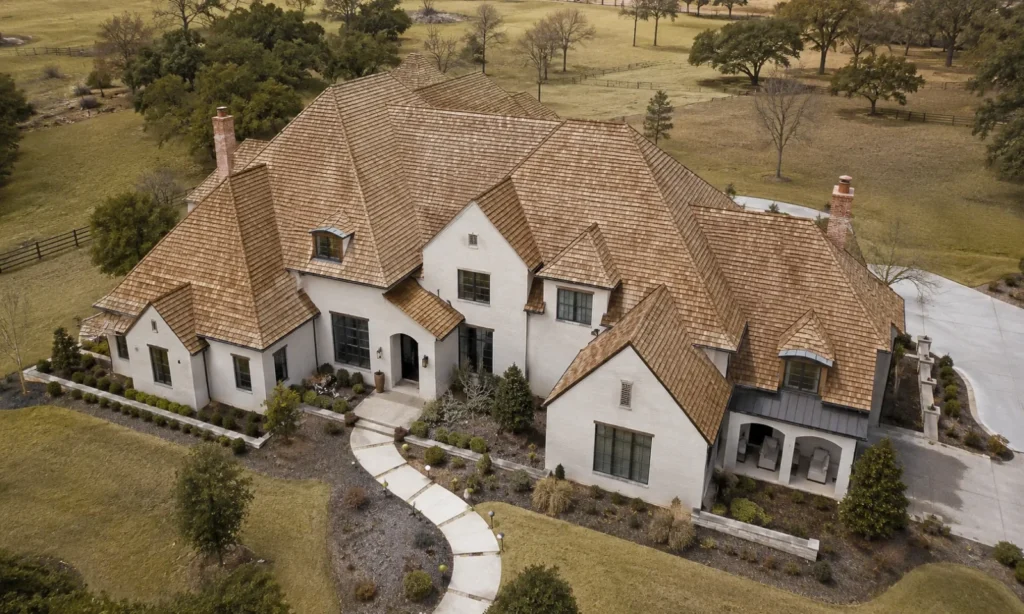
Alaska yellow cedar (also called yellow cedar or Nootka cypress) is the denser, naturally decay-resistant cousin of western red, for Farmersville owners who want cedar's look with more spine.
Yellow cedar’s tighter grain and natural oils resist decay and wear better than red cedar, it silvers to a distinctive even grey, and it costs accordingly. In Farmersville, it suits owners planning to keep a home long enough to collect the durability dividend.
We install and service alaska yellow cedar roofing across Farmersville and the surrounding DFW communities, with free written estimates, documented inspections, and honest guidance on whether this system actually fits your home and budget.
How Farmersville changes the math
The honest starting point for Alaska Yellow Cedar Roofing in Farmersville is the street you live on, not the sample board. Housing this far out is less uniform than the inner suburbs; age, pitch, and construction quality vary house to house, so the material fit does too. For those roofs, real wood is a character decision, and our job is keeping it honest about what North Texas sun and hail do to untreated shakes.
Permit-wise, this work in Farmersville runs through the city’s building department; filing it is our job, not yours. The weather here is not hypothetical: shakes split on impact and every carrier knows it, so documentation before and after storms is a cedar owner’s best friend. We work this system in Plano and Frisco as well. Ask and we will point you at nearby examples with a few years of weather on them. One inspection turns the general case into your case, with photos and numbers attached.
THE SYSTEM
Alaska Yellow Cedar Roofing, up close.
Cedar shake. Hand-split shakes across a complex roofline, with character that earns its maintenance.
PUBLIC RECORD
The local record behind Alaska Yellow Cedar Roofing in Farmersville
How a roof system holds up in Farmersville depends on the storms it has to take and the houses it sits on. Here is what the public record shows.
6
Hail days, 1 in.+ since 2006
4
Golf-ball-size hail days
2 in.
Largest stone on record
1980
Median year homes built
Hail near Farmersville
Reported hail is less frequent around Farmersville: NOAA lists 6 days since 2006 with hail one inch or larger within 4 miles. Fewer reports can also reflect fewer storm spotters in smaller communities, so a quiet record is not a guarantee. Hail that size was reported in 6 of the last 20 years. The largest stones on record nearby measured 2 inches (hen egg size) on June 11, 2023.
June 11, 2023: 2-inch hail (hen egg size)
October 24, 2010: 2-inch hail (hen egg size)
November 4, 2022: 1.75-inch hail (golf ball size)
May 28, 2015: 1.75-inch hail (golf ball size)
December 10, 2021: 1-inch hail (quarter size)
How old Farmersville homes are
The median home in Farmersville was built in 1980, and 50% of the city's 1,671 housing units predate 1980. Many of these houses are likely on their second roof or nearing the point where they need one.
Sources: NOAA National Centers for Environmental Information, Storm Events Database (hail reports since 2006 within 4 miles of Farmersville); U.S. Census Bureau, American Community Survey 2020–2024 5-year estimates. Data pulled September 2026.
Common questions about alaska yellow cedar roofing in Farmersville
Is Alaska yellow cedar worth the premium over red cedar in Farmersville?
For long-hold owners, often yes, since denser grain and natural decay resistance translate to service life. For shorter horizons, premium-grade red cedar is the value play.
Does yellow cedar weather differently?
It silvers to an even, distinctive grey rather than red cedar's variegated browns, and many owners consider the aged color its best argument.
Do you install this on shops and outbuildings near Farmersville?
Yes. Barns, workshops, and outbuildings are first-class projects out here, not afterthoughts, and the material conversation (usually metal-forward) covers them alongside the house.
How often does hail hit Farmersville?
NOAA lists 6 days since 2006 with hail one inch or larger within 4 miles of Farmersville. Smaller communities have fewer storm spotters, so reports tend to undercount what actually falls. The most recent report was 2-inch hail on June 11, 2023.
How old are most homes in Farmersville?
The median home in Farmersville was built in 1980, according to the U.S. Census Bureau's American Community Survey. 50% of the city's housing units predate 1980 and 27% were built in 2010 or later. Most homes here are well past the life of their original roof.