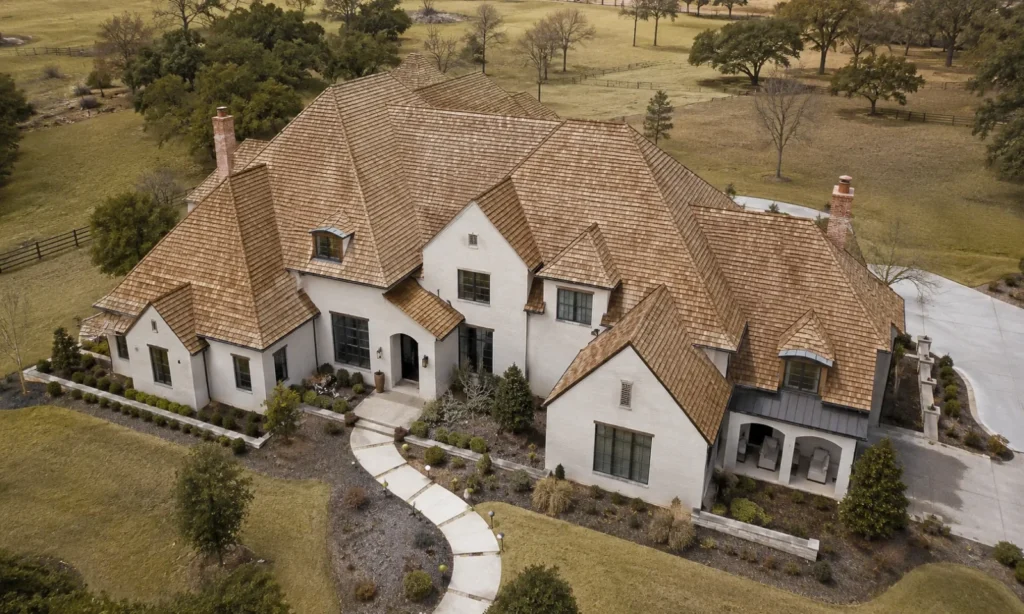
Cedar shake and shingle roofs (what many Fort Worth owners simply call wood roofs) offer a warmth no manufactured product fully matches, with maintenance realities worth walking into open-eyed.
Choosing cedar in Fort Worth is a commitment. It weathers beautifully and insulates naturally, and it asks more of both the installer and the owner than asphalt does. Fire treatment matters, ventilation matters twice as much, and DFW hail is harder on wood than on Class 4 composites. For owners who love the material, nothing replaces it; for owners drawn only to the look, our synthetic shake guide lays out the alternative honestly. Every estimate is free and in writing, every inspection comes with photos, deductibles are never waived under Texas law, and we do not act as a public adjuster.
Is a wood roof right for your Fort Worth home?
Start with the house. The median Fort Worth home was built in 1994, but the range is wide: 34 percent of housing units predate 1980 and 23 percent went up in 2010 or later. On older houses we expect to open up decking and ventilation before cedar goes down, since trapped heat and moisture shorten the life of a wood roof. Then weigh the weather. Hail records for Tarrant County show 98 days of one-inch-plus stones within 14 miles of the city since 2006, and the largest, 4.25 inches, fell on May 24, 2011. Cedar can live with that if the owner plans for regular inspections and repairs rather than hoping each storm misses. Our crews cover Sansom Park and Blue Mound from the same schedule.
THE SYSTEM
Cedar Roofing, up close.
Cedar shake. Hand-split shakes across a complex roofline, with character that earns its maintenance.
PUBLIC RECORD
The local record behind Cedar Roofing in Fort Worth
How a roof system holds up in Fort Worth depends on the storms it has to take and the houses it sits on. Here is what the public record shows.
98
Hail days, 1 in.+ since 2006
36
Golf-ball-size hail days
4.25 in.
Largest stone on record
1994
Median year homes built
Hail near Fort Worth
Hail is a regular event around Fort Worth. NOAA's Storm Events Database lists 98 separate days since 2006 with hail one inch or larger reported within 14 miles of the city, and on 36 of those days the stones reached golf ball size or bigger. Hail that size was reported in 20 of the last 20 years. The largest stones on record nearby measured 4.25 inches (grapefruit size) on May 24, 2011. The most recent report: 1-inch hail on May 25, 2026.
May 24, 2011: 4.25-inch hail (grapefruit size)
June 1, 2025: 3-inch hail (teacup size)
March 16, 2023: 3-inch hail (teacup size)
April 28, 2021: 3-inch hail (teacup size)
March 24, 2021: 3-inch hail (teacup size)
How old Fort Worth homes are
The median home in Fort Worth was built in 1994, and 34% of the city's 373,948 housing units predate 1980. Many of these houses are likely on their second roof or nearing the point where they need one.
Sources: NOAA National Centers for Environmental Information, Storm Events Database (hail reports since 2006 within 14 miles of Fort Worth); U.S. Census Bureau, American Community Survey 2020–2024 5-year estimates. Data pulled September 2026.
Common questions about cedar roofing in Fort Worth
How long does a cedar roof last in Fort Worth?
Well-installed, well-ventilated cedar typically serves twenty to thirty years in North Texas. DFW sun and hail are harder on wood than milder climates. Maintenance quality moves that range meaningfully.
Is cedar allowed under fire codes in Fort Worth?
Fire-treated cedar products meet the ratings most DFW jurisdictions require, while untreated shake generally does not. We confirm your city's specific requirements as part of any cedar project.
Does this material suit older Fort Worth homes?
Often, with eyes open: older decks get inspected board by board before any system goes down, and weight or structural questions get answered before quoting. The material conversation starts with what your specific roof can carry.
How often does hail hit Fort Worth?
NOAA's Storm Events Database lists 98 days since 2006 with hail one inch or larger reported within 14 miles of Fort Worth, including 36 days with golf ball size stones or bigger. Hail that size was reported in 20 of the last 20 years. The most recent report was 1-inch hail on May 25, 2026.
How old are most homes in Fort Worth?
The median home in Fort Worth was built in 1994, according to the U.S. Census Bureau's American Community Survey. 34% of the city's housing units predate 1980 and 23% were built in 2010 or later. Many homes here are reaching the age when original roofs come due.