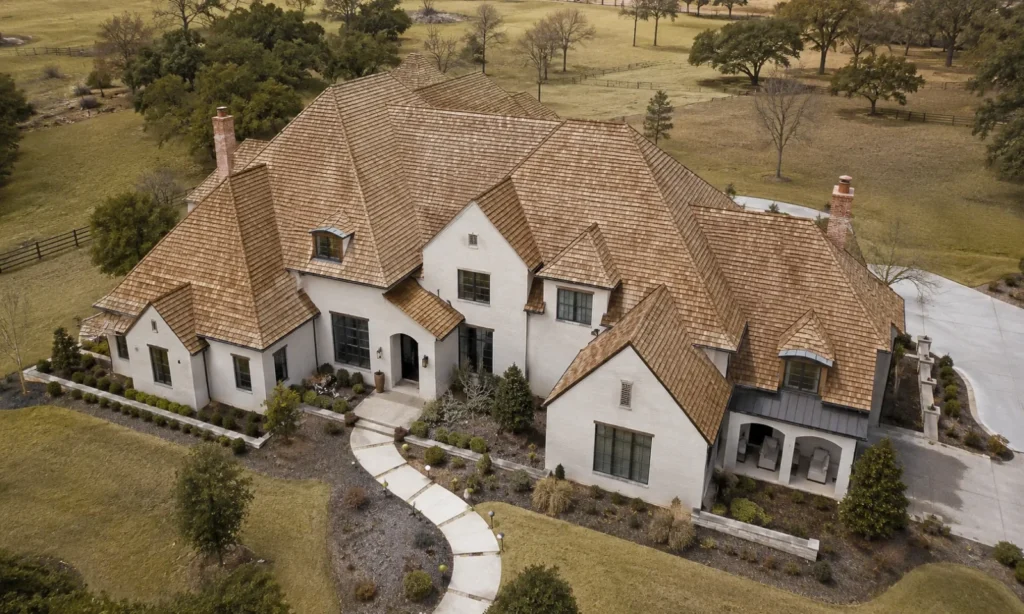
Western red cedar is the default cedar, the species most Allen shake and shingle roofs are made of, prized for its grain, workability, and natural weather resistance.
Western red is what most people mean when they say cedar roof. Hand-split shakes give a rough, deep texture, and sawn shingles give a tailored line. Grade matters enormously, since premium heartwood earns its price in service life. So does the air space underneath. Cedar breathes, and a roof that traps moisture below it ages in fast-forward, so ventilation is part of every red cedar job we scope in Allen.
We start with a free written estimate backed by a photo-documented inspection. Cedar Crest never waives deductibles, as Texas law requires, and we do not work as a public adjuster.
Choosing western red cedar grades for Allen hail
Grade selection carries extra weight in Allen because of how often the sky tests it. Since 2006 the area within 6 miles of the city has recorded 12 days of golf-ball size hail or larger, out of 27 days with hail at an inch or more. Thicker heartwood shakes take those hits better than thin, low-grade material, and a well-ventilated roof dries out properly between storms instead of holding water in the cracks.
The housing stock here is mostly modern. The median home dates to 2003, and only 7 percent were built before 1980, so a red cedar roof is usually a deliberate upgrade from the original shingles rather than a restoration. We handle those upgrades across Collin County, and the same crews install western red in Fairview and Lucas.
THE SYSTEM
Western Red Cedar Shake, up close.
Cedar shake. Hand-split shakes across a complex roofline, with character that earns its maintenance.
PUBLIC RECORD
The local record behind Western Red Cedar Shake in Allen
How a roof system holds up in Allen depends on the storms it has to take and the houses it sits on. Here is what the public record shows.
27
Hail days, 1 in.+ since 2006
12
Golf-ball-size hail days
4.5 in.
Largest stone on record
2003
Median year homes built
Hail near Allen
NOAA's Storm Events Database lists 27 days since 2006 with hail one inch or larger reported within 6 miles of Allen. On 12 of those days, the stones were golf ball size or bigger. Hail that size was reported in 13 of the last 20 years. The largest stones on record nearby measured 4.5 inches (softball size) on March 24, 2019. The most recent report: 1-inch hail on March 29, 2025.
March 24, 2019: 4.5-inch hail (softball size)
June 13, 2012: 3.25-inch hail (teacup size)
May 19, 2023: 2.5-inch hail (tennis ball size)
April 21, 2017: 2.5-inch hail (tennis ball size)
March 25, 2025: 2.25-inch hail (hen egg size)
How old Allen homes are
The median home in Allen was built in 2003. A large share of the city's 39,094 housing units are now old enough that original roofs are coming due, while 27% were built in 2010 or later.
Sources: NOAA National Centers for Environmental Information, Storm Events Database (hail reports since 2006 within 6 miles of Allen); U.S. Census Bureau, American Community Survey 2020–2024 5-year estimates. Data pulled September 2026.
Common questions about western red cedar shake in Allen
Shake or shingle: what is the difference?
Shakes are split, thicker, and textured; shingles are sawn, thinner, and tailored. Same species, different character: shakes read rustic, shingles read refined.
What cedar grade should I buy in Allen?
Premium heartwood grades. The price difference buys decay resistance and service life. Economy cedar grades in a DFW climate are a false saving.
Is upgrading from builder-grade shingles worth it in Allen?
Usually at the first replacement or claim: Class 4 impact-rated systems earn many Texas carriers' premium discounts, and newer communities' HOA standards generally approve them easily. The math works hardest on homes facing decades of DFW hail.
How often does hail hit Allen?
NOAA's Storm Events Database lists 27 days since 2006 with hail one inch or larger reported within 6 miles of Allen, including 12 days with golf ball size stones or bigger. Hail that size was reported in 13 of the last 20 years. The most recent report was 1-inch hail on March 29, 2025.
How old are most homes in Allen?
The median home in Allen was built in 2003, according to the U.S. Census Bureau's American Community Survey. 7% of the city's housing units predate 1980 and 27% were built in 2010 or later. Many homes here are reaching the age when original roofs come due.