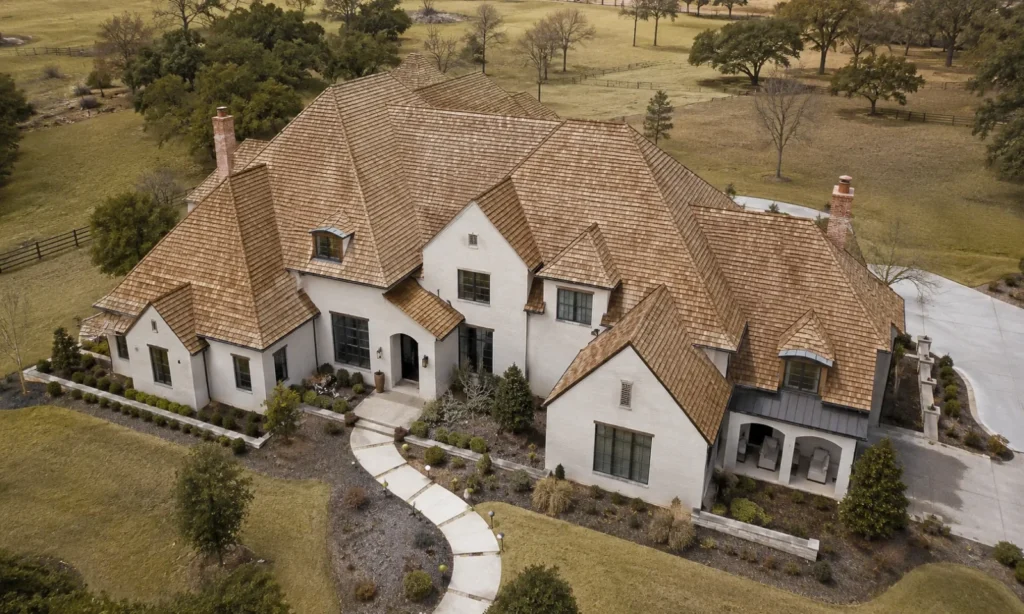
Western red cedar is the default cedar, the species most Blue Mound shake and shingle roofs are made of, prized for its grain, workability, and natural weather resistance.
When someone says cedar roof in Blue Mound, they usually mean western red: hand-split shakes for texture or sawn shingles for a tailored line. Grade matters enormously (premium heartwood grades earn their price in service life), and so does the air beneath: cedar breathes, and roofs that trap moisture under it age in fast-forward.
We install and service western red cedar shake across Blue Mound and the surrounding DFW communities. The work comes with free written estimates, documented inspections, and honest guidance on whether this system actually fits your home and budget.
Western Red Cedar Shake in Blue Mound, specifically
Blue Mound gives Western Red Cedar Shake a specific job to do, and it is worth naming. The neighborhoods skew established: multiple roof generations behind them, big tree canopies overhead, and original decking that deserves inspection before anything new goes on. Cedar on those houses is a commitment with a maintenance schedule attached. Honest owners budget for the care cycle or choose something that does not need one.
Like the rest of Tarrant County, Blue Mound wants roofing work documented: permits where required, inspections passed. That paperwork is included, not extra. Hail is the tax every DFW roof eventually pays. Shakes split on impact and every carrier knows it, which makes documentation before and after storms a cedar owner’s best friend. We work this system in Fort Worth and Arlington as well; ask and we will point you at nearby examples with a few years of weather on them. The estimate comes with the local specifics in writing: scope, grade, timeline, and both warranty layers.
THE SYSTEM
Western Red Cedar Shake, up close.
Cedar shake. Hand-split shakes across a complex roofline, with character that earns its maintenance.
PUBLIC RECORD
The local record behind Western Red Cedar Shake in Blue Mound
How a roof system holds up in Blue Mound depends on the storms it has to take and the houses it sits on. Here is what the public record shows.
20
Hail days, 1 in.+ since 2006
6
Golf-ball-size hail days
3 in.
Largest stone on record
1974
Median year homes built
Hail near Blue Mound
NOAA's Storm Events Database lists 20 days since 2006 with hail one inch or larger reported within 4 miles of Blue Mound. On 6 of those days, the stones were golf ball size or bigger. Hail that size was reported in 12 of the last 20 years. The largest stones on record nearby measured 3 inches (teacup size) on April 28, 2021. The most recent report: 1.75-inch hail on April 25, 2026.
April 28, 2021: 3-inch hail (teacup size)
April 13, 2007: 2.5-inch hail (tennis ball size)
April 25, 2026: 1.75-inch hail (golf ball size)
April 28, 2020: 1.75-inch hail (golf ball size)
May 11, 2012: 1.75-inch hail (golf ball size)
How old Blue Mound homes are
Half of Blue Mound's 813 housing units were built in 1974 or earlier, and 62% predate 1980. On homes that age, today's roof is rarely the original, and older decking, layered repairs and ventilation that was never brought up to date are common.
Sources: NOAA National Centers for Environmental Information, Storm Events Database (hail reports since 2006 within 4 miles of Blue Mound); U.S. Census Bureau, American Community Survey 2020–2024 5-year estimates. Data pulled September 2026.
Common questions about western red cedar shake in Blue Mound
Shake or shingle: what is the difference?
Shakes are split, thicker, and textured; shingles are sawn, thinner, and tailored. Same species, different character: shakes read rustic, shingles read refined.
What cedar grade should I buy in Blue Mound?
Premium heartwood grades. The price difference buys decay resistance and service life. Economy cedar grades in a DFW climate are a false saving.
Should we match the original material when re-roofing in Blue Mound?
Not automatically. A roof on its second or third cycle is a chance to rethink: Class 4 asphalt for the insurance math, metal or premium systems where the home and horizon justify them. We quote the honest options against your actual house.
How often does hail hit Blue Mound?
NOAA's Storm Events Database lists 20 days since 2006 with hail one inch or larger reported within 4 miles of Blue Mound, including 6 days with golf ball size stones or bigger. Hail that size was reported in 12 of the last 20 years. The most recent report was 1.75-inch hail on April 25, 2026.
How old are most homes in Blue Mound?
The median home in Blue Mound was built in 1974, according to the U.S. Census Bureau's American Community Survey. 62% of the city's housing units predate 1980 and 12% were built in 2010 or later. Most homes here are well past the life of their original roof.