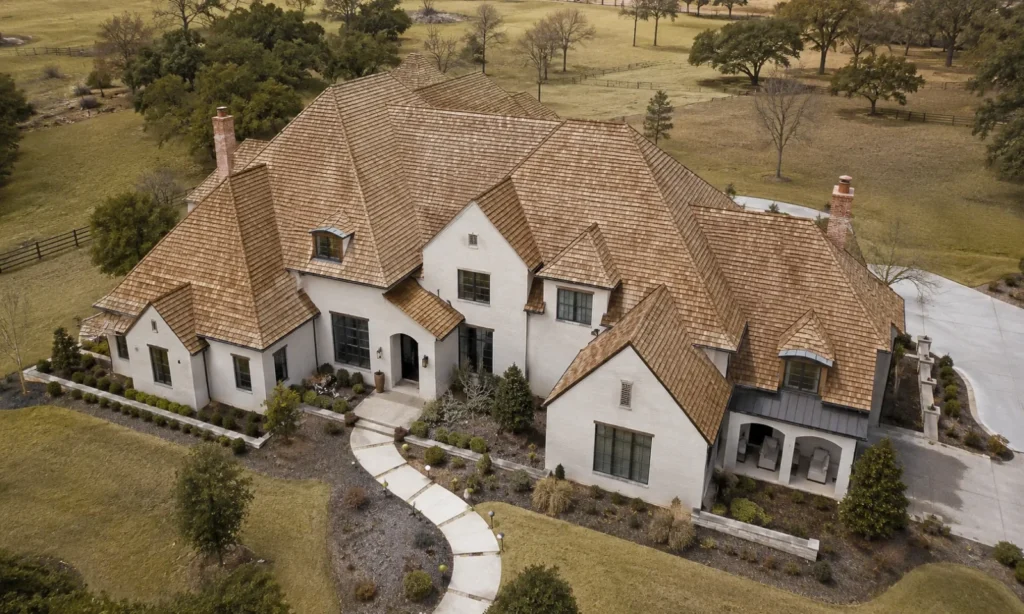
Western red cedar is the default cedar, the species most Lewisville shake and shingle roofs are made of, prized for its grain, workability, and natural weather resistance.
In Lewisville, a request for a cedar roof usually means western red: hand-split shakes for texture or sawn shingles for a tailored line. Grade matters a great deal, since premium heartwood grades earn their price in service life, and so does the air underneath. Cedar breathes, and roofs that trap moisture under it age fast.
We start with a free written estimate and an inspection documented in photos. We will not waive a deductible (Texas law is clear on that), and we are not a public adjuster.
Western red shakes and Lewisville hail
Shakes split on impact, and every carrier knows it. Around Lewisville that risk is regular rather than rare: within 7 miles, hail of golf-ball size or larger has fallen on 14 days since 2006, and the largest stone on record reached 3.0 inches on June 11, 2023. That argues for heartwood grades and for dated photos of the roof before each storm season.
Lewisville’s housing runs mostly 1980 through 2009, at 63 percent, and 23 percent is 2010 or newer, so a red cedar project here usually starts with the roof that is already up there rather than a blank deck. We look at it before we quote. Our Denton County crews work shake roofs in Highland Village and Hickory Creek on the same routes.
THE SYSTEM
Western Red Cedar Shake, up close.
Cedar shake. Hand-split shakes across a complex roofline, with character that earns its maintenance.
PUBLIC RECORD
The local record behind Western Red Cedar Shake in Lewisville
How a roof system holds up in Lewisville depends on the storms it has to take and the houses it sits on. Here is what the public record shows.
34
Hail days, 1 in.+ since 2006
14
Golf-ball-size hail days
3 in.
Largest stone on record
1997
Median year homes built
Hail near Lewisville
NOAA's Storm Events Database lists 34 days since 2006 with hail one inch or larger reported within 7 miles of Lewisville. On 14 of those days, the stones were golf ball size or bigger. Hail that size was reported in 15 of the last 20 years. The largest stones on record nearby measured 3 inches (teacup size) on June 11, 2023. The most recent report: 1-inch hail on June 8, 2025.
June 11, 2023: 3-inch hail (teacup size)
April 13, 2019: 2.75-inch hail (baseball size)
June 6, 2018: 2.75-inch hail (baseball size)
March 26, 2017: 2.75-inch hail (baseball size)
April 3, 2012: 2.75-inch hail (baseball size)
How old Lewisville homes are
The median home in Lewisville was built in 1997. A large share of the city's 54,237 housing units are now old enough that original roofs are coming due, while 23% were built in 2010 or later.
Sources: NOAA National Centers for Environmental Information, Storm Events Database (hail reports since 2006 within 7 miles of Lewisville); U.S. Census Bureau, American Community Survey 2020–2024 5-year estimates. Data pulled September 2026.
Common questions about western red cedar shake in Lewisville
Shake or shingle: what is the difference?
Shakes are split, thicker, and textured; shingles are sawn, thinner, and tailored. Same species, different character: shakes read rustic, shingles read refined.
What cedar grade should I buy in Lewisville?
Premium heartwood grades. The price difference buys decay resistance and service life. Economy cedar grades in a DFW climate are a false saving.
Do you install this on shops and outbuildings near Lewisville?
Yes. Barns, workshops, and outbuildings are first-class projects out here, not afterthoughts, and the material conversation (usually metal-forward) covers them alongside the house.
How often does hail hit Lewisville?
NOAA's Storm Events Database lists 34 days since 2006 with hail one inch or larger reported within 7 miles of Lewisville, including 14 days with golf ball size stones or bigger. Hail that size was reported in 15 of the last 20 years. The most recent report was 1-inch hail on June 8, 2025.
How old are most homes in Lewisville?
The median home in Lewisville was built in 1997, according to the U.S. Census Bureau's American Community Survey. 14% of the city's housing units predate 1980 and 23% were built in 2010 or later. Many homes here are reaching the age when original roofs come due.