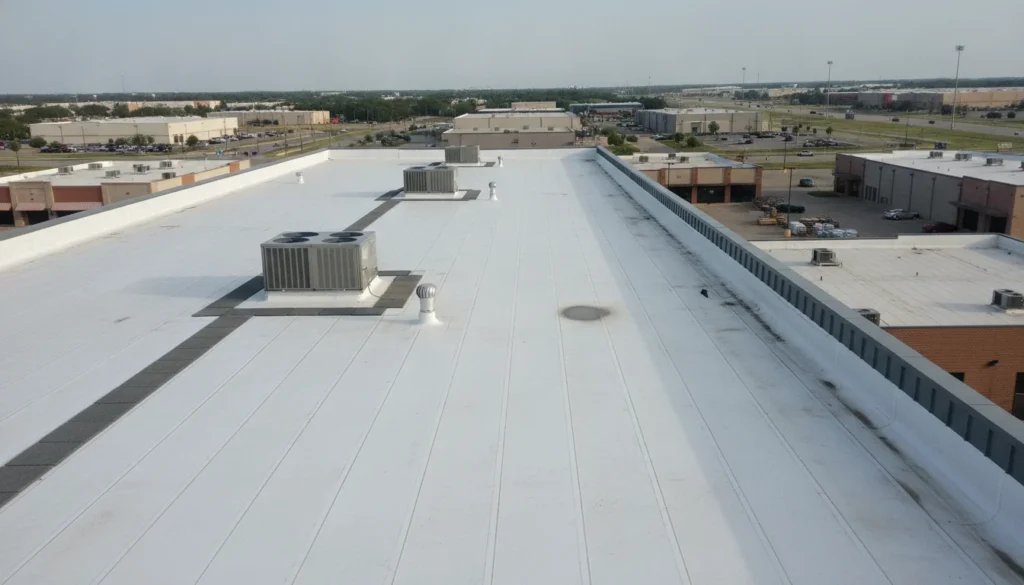
Built-up roofing, or tar and gravel, is the century-old system still protecting Everman buildings that were roofed before single-ply existed, and still a legitimate choice for the right structure.
BUR builds a roof in redundant layers: alternating bitumen and reinforcing felts topped with gravel that shields the assembly from UV and traffic. Existing BUR in Everman often earns maintenance and restoration over replacement, since the mass and redundancy that made it heavy also made it durable.
We install and service built-up roofing (bur) across Everman and the surrounding DFW communities. That includes free written estimates, documented inspections, and honest guidance on whether this system actually fits your building and budget.
Everman Hail and Commercial Roof Systems
Five days of golf-ball size or larger hail within 4 miles of Everman since 2006, led by 3-inch stones on June 1, 2025, give owners a practical benchmark for comparing commercial roof systems. Membranes, coatings and metal differ in how they absorb impact, how they age and how simple they are to patch. Maintenance carries as much weight as the initial choice: seams, penetrations, drains and edge metal are where hail damage usually becomes a leak. We document the condition of each system with photos and a written report, both after storms and during routine visits.
THE SYSTEM
Built-Up Roofing (BUR), up close.
Flat / low-slope membrane. Single-ply and built-up systems chosen by what the roof actually does all day.
PUBLIC RECORD
The local record behind Built-Up Roofing (BUR) in Everman
How a roof system holds up in Everman depends on the storms it has to take and the houses it sits on. Here is what the public record shows.
15
Hail days, 1 in.+ since 2006
5
Golf-ball-size hail days
3 in.
Largest stone on record
1968
Median year homes built
Hail near Everman
NOAA's Storm Events Database lists 15 days since 2006 with hail one inch or larger reported within 4 miles of Everman. On 5 of those days, the stones were golf ball size or bigger. Hail one inch or larger was reported in 10 of the last 20 years. The largest stones on record nearby measured 3 inches (teacup size) on June 1, 2025.
June 1, 2025: 3-inch hail (teacup size)
June 12, 2023: 1.75-inch hail (golf ball size)
April 24, 2011: 1.75-inch hail (golf ball size)
April 19, 2011: 1.75-inch hail (golf ball size)
March 31, 2008: 1.75-inch hail (golf ball size)
How old Everman homes are
Half of Everman's 2,159 housing units were built in 1968 or earlier, and 83% predate 1980. On homes that age, today's roof is rarely the original, and older decking, layered repairs and ventilation that was never brought up to date are common.
Sources: NOAA National Centers for Environmental Information, Storm Events Database (hail reports since 2006 within 4 miles of Everman); U.S. Census Bureau, American Community Survey 2020–2024 5-year estimates. Data pulled September 2026.
Common questions about built-up roofing (bur) in Everman
My Everman building has tar-and-gravel. Replace it?
Not automatically. Sound BUR restores and maintains well; its redundancy is real. A moisture survey tells you whether the assembly beneath the gravel is dry, and that answer decides.
Why did BUR fall out of fashion?
Weight, installation labor, and odor during application. Single-ply installs faster and lighter. Neither of those points makes an existing sound BUR roof bad.
Should we match the original material when re-roofing in Everman?
Not automatically. A roof on its second or third cycle is a chance to rethink: Class 4 asphalt for the insurance math, metal or premium systems where the home and horizon justify them. We quote the honest options against your actual building.
How often does hail hit Everman?
NOAA's Storm Events Database lists 15 days since 2006 with hail one inch or larger reported within 4 miles of Everman, including 5 days with golf ball size stones or bigger. Hail one inch or larger was reported in 10 of the last 20 years. The most recent report was 3-inch hail on June 1, 2025.
How old are most homes in Everman?
The median home in Everman was built in 1968, according to the U.S. Census Bureau's American Community Survey. 83% of the city's housing units predate 1980 and 1% were built in 2010 or later. Most homes here are well past the life of their original roof.