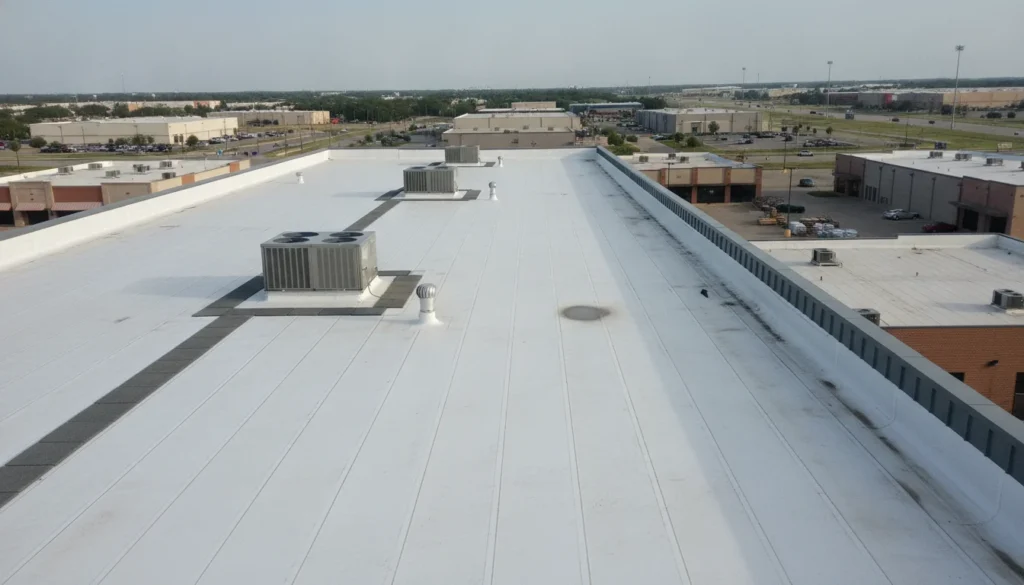
Built-up roofing, or tar and gravel, is the century-old system still protecting Fort Worth buildings that were roofed before single-ply existed, and still a legitimate choice for the right structure.
Built-up roofing earns its durability through redundancy: alternating layers of bitumen and reinforcing felts, capped with gravel that shields the assembly from UV and foot traffic. The same mass that makes BUR heavy makes it last, so an existing built-up roof on a Fort Worth building often earns maintenance and restoration before anyone talks about replacement. Assessments come with a free written estimate and an inspection documented with photos. We do not waive deductibles, which Texas law prohibits, and we are not a public adjuster.
Keeping built-up roofs working in Fort Worth
Gravel-surfaced BUR hides damage well, which matters in a city with this storm record. Since 2006, the 14-mile area around Fort Worth has seen 98 days of one-inch-plus hail, including 36 days at golf-ball size or larger, and a 4.25-inch stone on May 24, 2011. After a storm we look beneath the gravel at the plies and flashings rather than judging the surface, and we photograph what we find. The age of the city points the same way: 34 percent of Fort Worth housing units were built before 1980, a reminder that this Tarrant County city has a deep stock of older buildings where restoring a sound roof often beats starting over. Our crews handle BUR work in River Oaks and Sansom Park as well.
THE SYSTEM
Built-Up Roofing (BUR), up close.
Flat / low-slope membrane. Single-ply and built-up systems chosen by what the roof actually does all day.
PUBLIC RECORD
The local record behind Built-Up Roofing (BUR) in Fort Worth
How a roof system holds up in Fort Worth depends on the storms it has to take and the houses it sits on. Here is what the public record shows.
98
Hail days, 1 in.+ since 2006
36
Golf-ball-size hail days
4.25 in.
Largest stone on record
1994
Median year homes built
Hail near Fort Worth
Hail is a regular event around Fort Worth. NOAA's Storm Events Database lists 98 separate days since 2006 with hail one inch or larger reported within 14 miles of the city, and on 36 of those days the stones reached golf ball size or bigger. Hail that size was reported in 20 of the last 20 years. The largest stones on record nearby measured 4.25 inches (grapefruit size) on May 24, 2011. The most recent report: 1-inch hail on May 25, 2026.
May 24, 2011: 4.25-inch hail (grapefruit size)
June 1, 2025: 3-inch hail (teacup size)
March 16, 2023: 3-inch hail (teacup size)
April 28, 2021: 3-inch hail (teacup size)
March 24, 2021: 3-inch hail (teacup size)
How old Fort Worth homes are
The median home in Fort Worth was built in 1994, and 34% of the city's 373,948 housing units predate 1980. Many of these houses are likely on their second roof or nearing the point where they need one.
Sources: NOAA National Centers for Environmental Information, Storm Events Database (hail reports since 2006 within 14 miles of Fort Worth); U.S. Census Bureau, American Community Survey 2020–2024 5-year estimates. Data pulled September 2026.
Common questions about built-up roofing (bur) in Fort Worth
My Fort Worth building has tar-and-gravel. Replace it?
Not automatically. Sound BUR restores and maintains well; its redundancy is real. A moisture survey tells you whether the assembly beneath the gravel is dry, and that answer decides.
Why did BUR fall out of fashion?
Weight, installation labor, and odor during application. Single-ply installs faster and lighter. Neither of those points makes an existing sound BUR roof bad.
Does this material suit older Fort Worth homes?
Often, with eyes open: older decks get inspected board by board before any system goes down, and weight or structural questions get answered before quoting. The material conversation starts with what your specific roof can carry.
How often does hail hit Fort Worth?
NOAA's Storm Events Database lists 98 days since 2006 with hail one inch or larger reported within 14 miles of Fort Worth, including 36 days with golf ball size stones or bigger. Hail that size was reported in 20 of the last 20 years. The most recent report was 1-inch hail on May 25, 2026.
How old are most homes in Fort Worth?
The median home in Fort Worth was built in 1994, according to the U.S. Census Bureau's American Community Survey. 34% of the city's housing units predate 1980 and 23% were built in 2010 or later. Many homes here are reaching the age when original roofs come due.