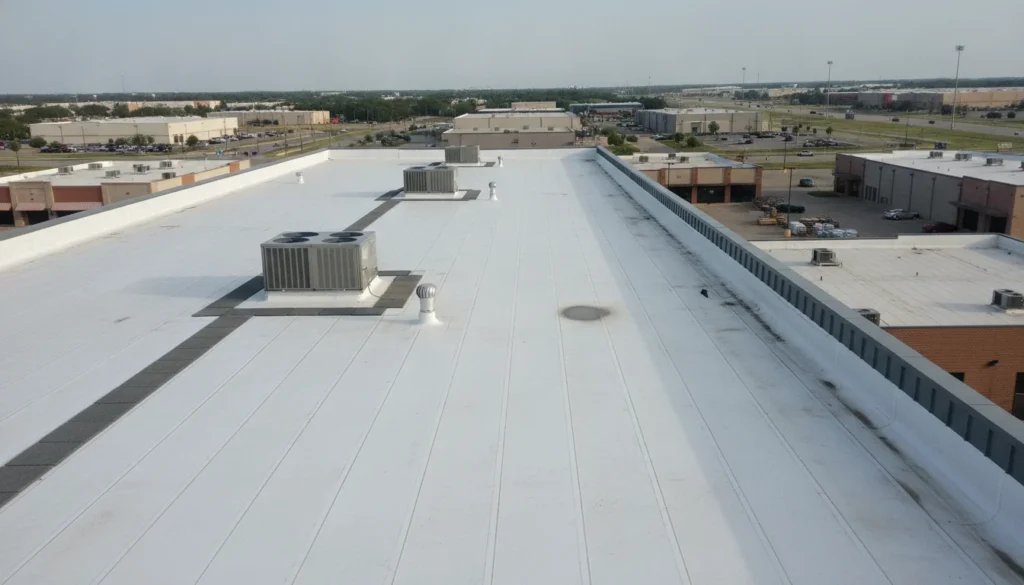
Built-up roofing, or tar and gravel, is the century-old system still protecting Lake Dallas buildings that were roofed before single-ply existed, and still a legitimate choice for the right structure.
BUR builds a roof in redundant layers: alternating bitumen and reinforcing felts topped with gravel that shields the assembly from UV and traffic. Existing BUR in Lake Dallas often earns maintenance and restoration over replacement, since the mass and redundancy that made it heavy also made it durable.
We install and service built-up roofing (bur) across Lake Dallas and the surrounding DFW communities. That includes free written estimates, documented inspections, and honest guidance on whether this system actually fits your building and budget.
Lake Dallas Hail Sizes and Commercial Roofing Materials
Because 4 of the 6 golf-ball size or larger hail days near Lake Dallas since 2006 also reached tennis-ball size or larger, system choice here tends to turn partly on impact tolerance. Membranes, coatings, built-up and modified systems, and metal panels differ in how they resist punctures and how visible damage is afterward. Whatever is installed, a regular inspection cycle and a post-storm check usually catch fractures and dents early, and photographed records make it easier to show insurers what changed after a storm like March 26, 2017, when stones measured 2.75 inches.
THE SYSTEM
Built-Up Roofing (BUR), up close.
Flat / low-slope membrane. Single-ply and built-up systems chosen by what the roof actually does all day.
PUBLIC RECORD
The local record behind Built-Up Roofing (BUR) in Lake Dallas
How a roof system holds up in Lake Dallas depends on the storms it has to take and the houses it sits on. Here is what the public record shows.
20
Hail days, 1 in.+ since 2006
6
Golf-ball-size hail days
2.75 in.
Largest stone on record
1998
Median year homes built
Hail near Lake Dallas
NOAA's Storm Events Database lists 20 days since 2006 with hail one inch or larger reported within 4 miles of Lake Dallas. On 6 of those days, the stones were golf ball size or bigger. Hail one inch or larger was reported in 12 of the last 20 years. The largest stones on record nearby measured 2.75 inches (baseball size) on March 26, 2017. The most recent report: 1-inch hail on June 8, 2025.
March 26, 2017: 2.75-inch hail (baseball size)
April 11, 2016: 2.75-inch hail (baseball size)
March 31, 2008: 2.75-inch hail (baseball size)
June 11, 2023: 2.5-inch hail (tennis ball size)
March 14, 2024: 2-inch hail (hen egg size)
How old Lake Dallas homes are
The median home in Lake Dallas was built in 1998. A large share of the city's 3,294 housing units are now old enough that original roofs are coming due, while 14% were built in 2010 or later.
Sources: NOAA National Centers for Environmental Information, Storm Events Database (hail reports since 2006 within 4 miles of Lake Dallas); U.S. Census Bureau, American Community Survey 2020–2024 5-year estimates. Data pulled September 2026.
Common questions about built-up roofing (bur) in Lake Dallas
My Lake Dallas building has tar-and-gravel. Replace it?
Not automatically. Sound BUR restores and maintains well; its redundancy is real. A moisture survey tells you whether the assembly beneath the gravel is dry, and that answer decides.
Why did BUR fall out of fashion?
Weight, installation labor, and odor during application. Single-ply installs faster and lighter. Neither of those points makes an existing sound BUR roof bad.
Do you install this on shops and outbuildings near Lake Dallas?
Yes. Barns, workshops, and outbuildings are first-class projects out here, not afterthoughts, and the material conversation (usually metal-forward) covers them alongside the house.
How often does hail hit Lake Dallas?
NOAA's Storm Events Database lists 20 days since 2006 with hail one inch or larger reported within 4 miles of Lake Dallas, including 6 days with golf ball size stones or bigger. Hail one inch or larger was reported in 12 of the last 20 years. The most recent report was 1-inch hail on June 8, 2025.
How old are most homes in Lake Dallas?
The median home in Lake Dallas was built in 1998, according to the U.S. Census Bureau's American Community Survey. 15% of the city's housing units predate 1980 and 14% were built in 2010 or later. Many homes here are reaching the age when original roofs come due.