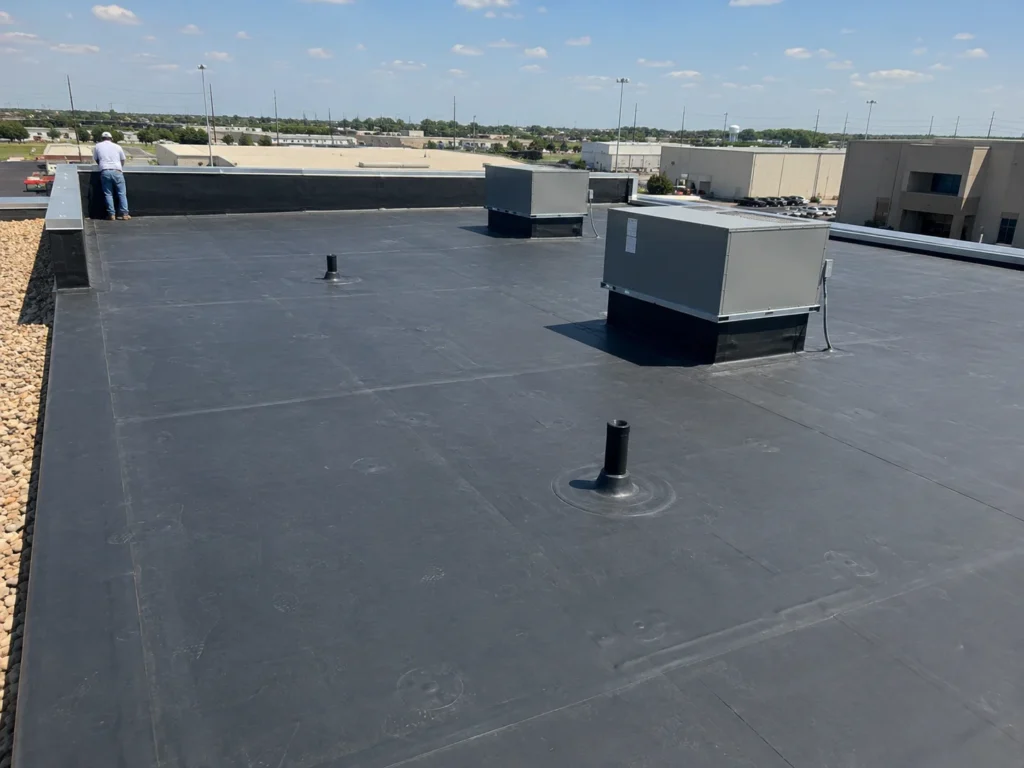
EPDM, the black rubber membrane, has half a century of track record on commercial roofs, and plenty of Aurora buildings are wearing it right now.
EPDM’s case is proven longevity and repairability: the material tolerates decades of weather, and repairs are straightforward for crews who know the system. Its black surface absorbs Texas heat, a real operating-cost consideration in Aurora, which is why new installs often weigh TPO first while existing EPDM roofs frequently earn repair and restoration rather than replacement.
We install and service epdm roofing across Aurora and the surrounding DFW communities, with free written estimates, documented inspections, and honest guidance on whether this system actually fits your home and budget.
The local case in Aurora
Every city wears this system a little differently, and Aurora is no exception. Housing this far out is less uniform than the inner suburbs. Age, pitch, and construction quality vary house to house, and the material fit varies with them. That building stock puts membranes to work: seams, penetrations, and drainage patterns matter more than brand names, and the moisture survey decides restore-versus-replace.
The permit runs through Aurora’s building department; we handle the filing and the inspection scheduling as part of the job. North Texas sits in the country’s most active hail belt, and single-ply shows bruise fractures that a chalk circle will not catch; instrument surveys find what walking the roof misses. The same crews run Decatur, Bridgeport, and Boyd, so comparable local installs are usually close enough to go look at. When we quote it, ask for nearby addresses, because a real roof with weather on it is the honest brochure.
THE SYSTEM
EPDM Roofing, up close.
EPDM membrane. Fully-adhered black rubber in seamless sheets: the low-slope workhorse.
PUBLIC RECORD
The local record behind EPDM Roofing in Aurora
How a roof system holds up in Aurora depends on the storms it has to take and the houses it sits on. Here is what the public record shows.
11
Hail days, 1 in.+ since 2006
6
Golf-ball-size hail days
4.25 in.
Largest stone on record
2001
Median year homes built
Hail near Aurora
Reported hail is less frequent around Aurora: NOAA lists 11 days since 2006 with hail one inch or larger within 4 miles. Fewer reports can also reflect fewer storm spotters in smaller communities, so a quiet record is not a guarantee. Hail that size was reported in 8 of the last 20 years. The largest stones on record nearby measured 4.25 inches (grapefruit size) on May 7, 2015. The most recent report: 1.75-inch hail on November 24, 2025.
May 7, 2015: 4.25-inch hail (grapefruit size)
April 8, 2024: 3-inch hail (teacup size)
April 1, 2024: 2-inch hail (hen egg size)
November 24, 2025: 1.75-inch hail (golf ball size)
May 3, 2021: 1.75-inch hail (golf ball size)
How old Aurora homes are
The median home in Aurora was built in 2001. A large share of the city's 592 housing units are now old enough that original roofs are coming due, while 30% were built in 2010 or later.
Sources: NOAA National Centers for Environmental Information, Storm Events Database (hail reports since 2006 within 4 miles of Aurora); U.S. Census Bureau, American Community Survey 2020–2024 5-year estimates. Data pulled September 2026.
Common questions about epdm roofing in Aurora
Is EPDM outdated compared to TPO in Aurora?
No, different trade-offs. EPDM has the longest single-ply track record and repairs well; its black surface absorbs heat that white TPO reflects. Existing EPDM in sound condition usually argues for maintenance, not replacement.
How long does EPDM last?
Decades. Well-maintained EPDM commonly reaches twenty-five to thirty years, and restoration coatings can extend sound membranes further.
Do you install this on shops and outbuildings near Aurora?
Yes. Barns, workshops, and outbuildings are first-class projects out here, not afterthoughts, and the material conversation (usually metal-forward) covers them alongside the house.
How often does hail hit Aurora?
NOAA lists 11 days since 2006 with hail one inch or larger within 4 miles of Aurora. Smaller communities have fewer storm spotters, so reports tend to undercount what actually falls. The most recent report was 1.75-inch hail on November 24, 2025.
How old are most homes in Aurora?
The median home in Aurora was built in 2001, according to the U.S. Census Bureau's American Community Survey. 19% of the city's housing units predate 1980 and 30% were built in 2010 or later. Many homes here are reaching the age when original roofs come due.