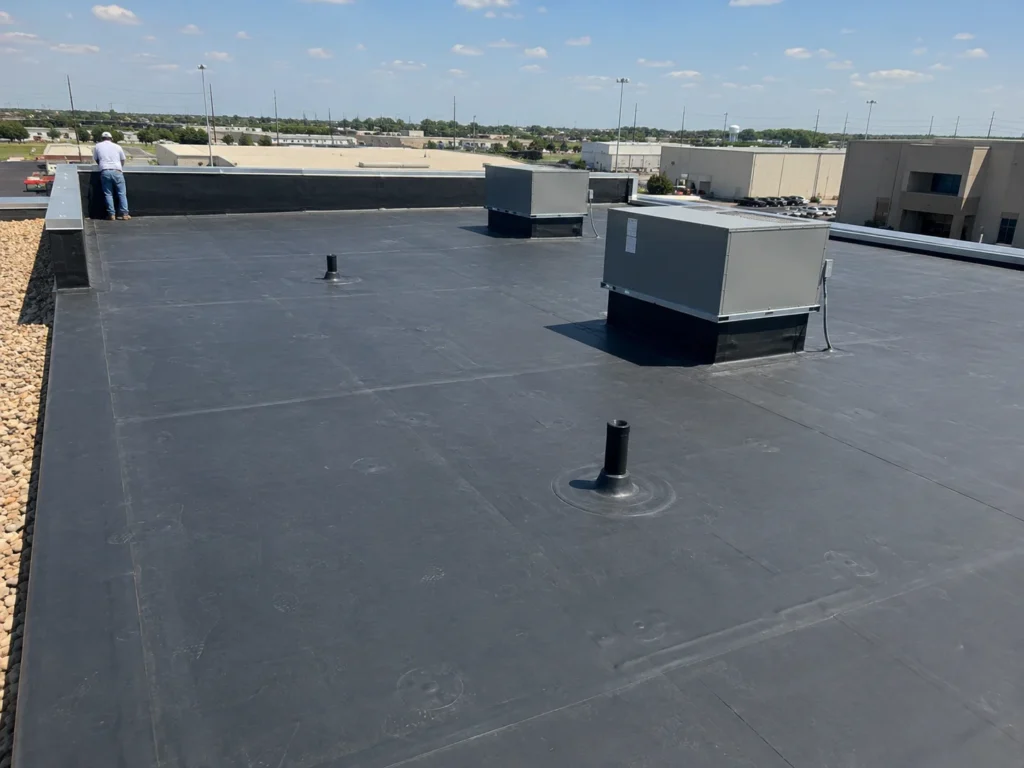
EPDM, the black rubber membrane, has half a century of track record on commercial roofs, and plenty of Lewisville buildings are wearing it right now.
EPDM’s argument is proven longevity and straightforward repair: the rubber tolerates decades of weather, and crews who know the system can patch it cleanly. Its black surface absorbs Texas heat, which is a real operating cost in Lewisville, so new installs often weigh TPO first while existing EPDM roofs frequently earn repair and restoration instead of replacement.
Estimates are free and in writing, inspections come with photos, deductibles are never waived under Texas law, and Cedar Crest is not a public adjuster.
Repair or replace: EPDM decisions in Lewisville
Hail changes the math on a rubber roof. Lewisville has recorded golf-ball hail or larger on 14 days since 2006 within a 7-mile radius, and the biggest stone reached 3.0 inches on June 11, 2023. Impact damage on single-ply does not always show on a walk, so we document the membrane, seams and flashings with photos after storms rather than guessing. For owners weighing a restoration, that record also shows whether the sheet has life left.
The city’s growth, with 63 percent of homes built from 1980 through 2009, left plenty of roofs across Lewisville at the age where this decision comes up. Our Denton County crews do the same EPDM work in The Colony and Lake Dallas.
THE SYSTEM
EPDM Roofing, up close.
EPDM membrane. Fully-adhered black rubber in seamless sheets: the low-slope workhorse.
PUBLIC RECORD
The local record behind EPDM Roofing in Lewisville
How a roof system holds up in Lewisville depends on the storms it has to take and the houses it sits on. Here is what the public record shows.
34
Hail days, 1 in.+ since 2006
14
Golf-ball-size hail days
3 in.
Largest stone on record
1997
Median year homes built
Hail near Lewisville
NOAA's Storm Events Database lists 34 days since 2006 with hail one inch or larger reported within 7 miles of Lewisville. On 14 of those days, the stones were golf ball size or bigger. Hail that size was reported in 15 of the last 20 years. The largest stones on record nearby measured 3 inches (teacup size) on June 11, 2023. The most recent report: 1-inch hail on June 8, 2025.
June 11, 2023: 3-inch hail (teacup size)
April 13, 2019: 2.75-inch hail (baseball size)
June 6, 2018: 2.75-inch hail (baseball size)
March 26, 2017: 2.75-inch hail (baseball size)
April 3, 2012: 2.75-inch hail (baseball size)
How old Lewisville homes are
The median home in Lewisville was built in 1997. A large share of the city's 54,237 housing units are now old enough that original roofs are coming due, while 23% were built in 2010 or later.
Sources: NOAA National Centers for Environmental Information, Storm Events Database (hail reports since 2006 within 7 miles of Lewisville); U.S. Census Bureau, American Community Survey 2020–2024 5-year estimates. Data pulled September 2026.
Common questions about epdm roofing in Lewisville
Is EPDM outdated compared to TPO in Lewisville?
No, different trade-offs. EPDM has the longest single-ply track record and repairs well; its black surface absorbs heat that white TPO reflects. Existing EPDM in sound condition usually argues for maintenance, not replacement.
How long does EPDM last?
Decades. Well-maintained EPDM commonly reaches twenty-five to thirty years, and restoration coatings can extend sound membranes further.
Do you install this on shops and outbuildings near Lewisville?
Yes. Barns, workshops, and outbuildings are first-class projects out here, not afterthoughts, and the material conversation (usually metal-forward) covers them alongside the house.
How often does hail hit Lewisville?
NOAA's Storm Events Database lists 34 days since 2006 with hail one inch or larger reported within 7 miles of Lewisville, including 14 days with golf ball size stones or bigger. Hail that size was reported in 15 of the last 20 years. The most recent report was 1-inch hail on June 8, 2025.
How old are most homes in Lewisville?
The median home in Lewisville was built in 1997, according to the U.S. Census Bureau's American Community Survey. 14% of the city's housing units predate 1980 and 23% were built in 2010 or later. Many homes here are reaching the age when original roofs come due.