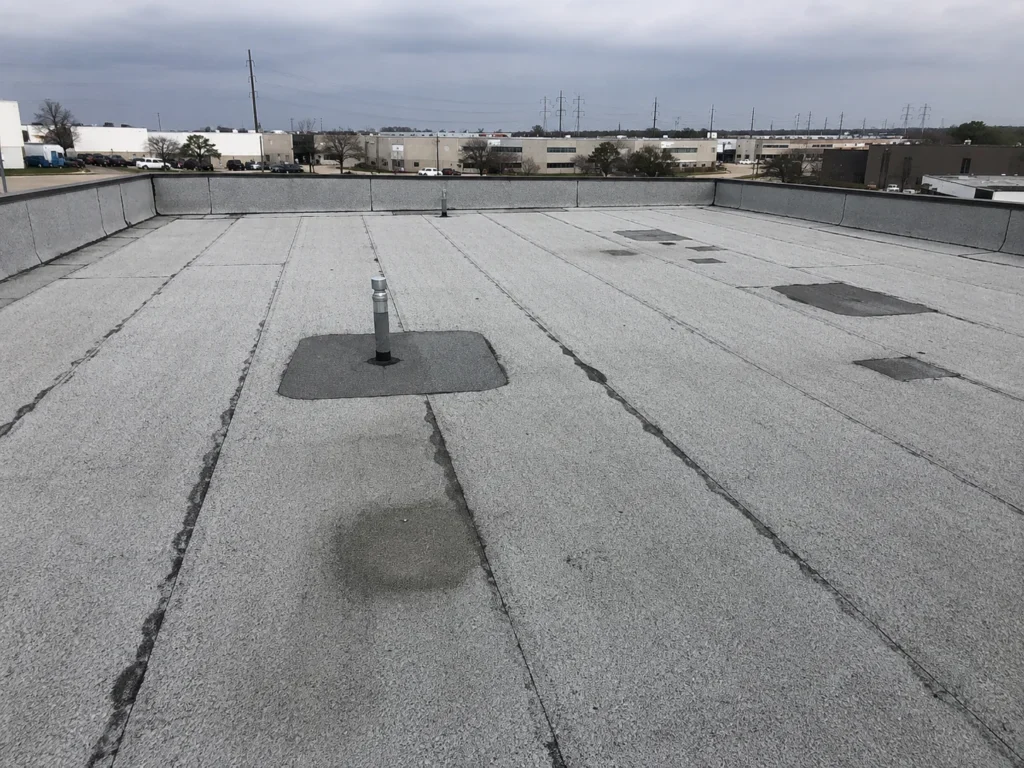
Modified bitumen (mod-bit) is asphalt roofing engineered for low slopes: multi-ply redundancy and a puncture toughness single-ply membranes cannot match.
Modified bitumen argues for itself with layers. Two or more plies of polymer-modified asphalt build a roof with backup, so a puncture has to get through redundancy rather than a single membrane. It handles rooftop foot traffic well, which suits Dallas buildings whose roofs double as equipment yards, and modern cold-applied and self-adhered systems have retired most of the old torch-down fire concerns. Estimates are free and put in writing; inspections are documented with photos. Deductibles are never waived, per Texas law, and Cedar Crest does not work as a public adjuster.
Mod-Bit Redundancy and the Dallas Hail Belt
Redundancy matters in a city that sees hail this often. Dallas has had inch-plus hail in each of the last 20 years, 77 such days since 2006, and 25 days with golf-ball-size stones or larger. The record, 4.25 inches, fell on May 24, 2011. A multi-ply mod-bit roof gives a stone more to get through, and equipment-heavy roofs benefit from a surface that tolerates service traffic between storms. Many Dallas roofs also carry history: the median year built for local housing is 1981, and 38 percent of units date from 1980 through 2009, so layered repairs and patched decking are common when we open an older assembly. Seams, penetrations, and drainage patterns matter more than brand names. Mod-bit crews working Dallas County also take jobs in Cockrell Hill and Highland Park.
THE SYSTEM
Modified Bitumen Roofing, up close.
Modified bitumen. Granule-surfaced torch-down sheets, lapped and sealed, an asphalt system laid flat.
PUBLIC RECORD
The local record behind Modified Bitumen Roofing in Dallas
How a roof system holds up in Dallas depends on the storms it has to take and the houses it sits on. Here is what the public record shows.
77
Hail days, 1 in.+ since 2006
25
Golf-ball-size hail days
4.25 in.
Largest stone on record
1981
Median year homes built
Hail near Dallas
Hail is a regular event around Dallas. NOAA's Storm Events Database lists 77 separate days since 2006 with hail one inch or larger reported within 13 miles of the city, and on 25 of those days the stones reached golf ball size or bigger. Hail that size was reported in 20 of the last 20 years. The largest stones on record nearby measured 4.25 inches (grapefruit size) on May 24, 2011. The most recent report: 1.5-inch hail on June 2, 2026.
May 24, 2011: 4.25-inch hail (grapefruit size)
April 25, 2026: 3-inch hail (teacup size)
June 6, 2018: 3-inch hail (teacup size)
June 13, 2012: 3-inch hail (teacup size)
April 3, 2012: 2.75-inch hail (baseball size)
How old Dallas homes are
The median home in Dallas was built in 1981, and 48% of the city's 590,237 housing units predate 1980. Many of these houses are likely on their second roof or nearing the point where they need one.
Sources: NOAA National Centers for Environmental Information, Storm Events Database (hail reports since 2006 within 13 miles of Dallas); U.S. Census Bureau, American Community Survey 2020–2024 5-year estimates. Data pulled September 2026.
Common questions about modified bitumen roofing in Dallas
Is torch-down roofing safe?
Modern mod-bit rarely needs torches, since cold-applied adhesives and self-adhered sheets install without open flame. Where torch application is used, certified crews and fire-watch protocols are non-negotiable.
When does mod-bit beat single-ply in Dallas?
Heavy rooftop traffic and equipment service. The multi-ply build tolerates the abuse that punctures single membranes. Buildings whose roofs are working platforms are mod-bit's home field.
Does this material suit older Dallas homes?
Often, with eyes open: older decks get inspected board by board before any system goes down, and weight or structural questions get answered before quoting. The material conversation starts with what your specific roof can carry.
How often does hail hit Dallas?
NOAA's Storm Events Database lists 77 days since 2006 with hail one inch or larger reported within 13 miles of Dallas, including 25 days with golf ball size stones or bigger. Hail that size was reported in 20 of the last 20 years. The most recent report was 1.5-inch hail on June 2, 2026.
How old are most homes in Dallas?
The median home in Dallas was built in 1981, according to the U.S. Census Bureau's American Community Survey. 48% of the city's housing units predate 1980 and 14% were built in 2010 or later. Most homes here are well past the life of their original roof.