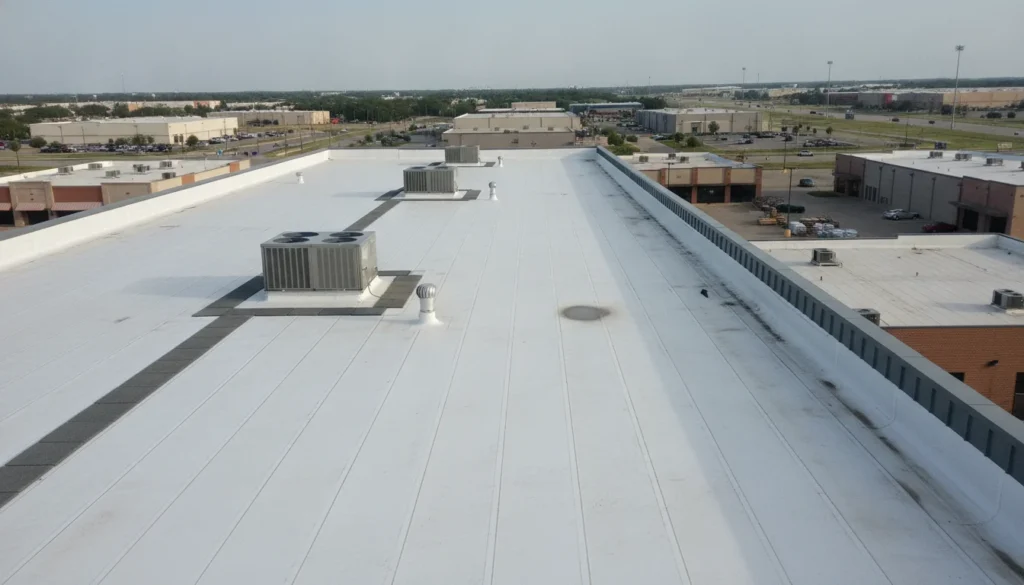
PVC is the membrane that shrugs off grease and chemicals, which is why Bedford restaurants and food-service buildings specify it over everything else.
Kitchen exhaust is brutal on most membranes, and PVC is formulated to resist the oils and fats that break down TPO and EPDM around vents. With heat-welded seams, strong reflectivity, and chemical resistance, PVC is the specification for any Bedford roof downstream of a grease stack: restaurants, groceries, and food processing. Before any work, owners get a free estimate in writing and an inspection file with photos. We never waive deductibles, as Texas law requires, and Cedar Crest does not serve as a public adjuster.
PVC for Bedford Restaurants and Grocers
Food-service roofs in Bedford deal with grease from the exhaust below and hail from above. Since 2006, hail an inch or larger has fallen within 5 miles of the city on 25 days, and the biggest stone measured 3.0 inches on April 13, 2007. Around grease stacks, the membrane is already under chemical stress, which is why PVC’s resistance to oils matters most at those vents. After storms, we check the welded seams and the areas around exhaust fans first, then document the rest of the roof in photos. If a building is not a PVC candidate, the assessment says so, and the owner still keeps the photo file. Our crews handle PVC work across Tarrant County, including neighboring Hurst and Euless.
THE SYSTEM
PVC Roofing, up close.
PVC membrane. Welded single-ply built for chemical and grease resistance on demanding roofs.
PUBLIC RECORD
The local record behind PVC Roofing in Bedford
How a roof system holds up in Bedford depends on the storms it has to take and the houses it sits on. Here is what the public record shows.
25
Hail days, 1 in.+ since 2006
8
Golf-ball-size hail days
3 in.
Largest stone on record
1983
Median year homes built
Hail near Bedford
NOAA's Storm Events Database lists 25 days since 2006 with hail one inch or larger reported within 5 miles of Bedford. On 8 of those days, the stones were golf ball size or bigger. Hail that size was reported in 14 of the last 20 years. The largest stones on record nearby measured 3 inches (teacup size) on April 13, 2007. The most recent report: 1-inch hail on August 3, 2025.
April 13, 2007: 3-inch hail (teacup size)
May 27, 2024: 2.75-inch hail (baseball size)
April 3, 2012: 2.75-inch hail (baseball size)
April 6, 2018: 2-inch hail (hen egg size)
April 19, 2011: 2-inch hail (hen egg size)
How old Bedford homes are
The median home in Bedford was built in 1983, and 38% of the city's 21,878 housing units predate 1980. Many of these houses are likely on their second roof or nearing the point where they need one.
Sources: NOAA National Centers for Environmental Information, Storm Events Database (hail reports since 2006 within 5 miles of Bedford); U.S. Census Bureau, American Community Survey 2020–2024 5-year estimates. Data pulled September 2026.
Common questions about pvc roofing in Bedford
Why does my restaurant roof in Bedford need PVC specifically?
Grease resistance. Kitchen exhaust deposits oils that degrade other membranes around the vents. PVC is formulated for that exposure, which is why food-service specifications call for it.
Is PVC worth it on a non-restaurant building?
Sometimes. Its chemical resistance and seam strength are real. Without grease or chemical exposure, TPO usually delivers similar performance at friendlier cost.
Should we match the original material when re-roofing in Bedford?
Not automatically. A roof on its second or third cycle is a chance to rethink: Class 4 asphalt for the insurance math, metal or premium systems where the home and horizon justify them. We quote the honest options against your actual house.
How often does hail hit Bedford?
NOAA's Storm Events Database lists 25 days since 2006 with hail one inch or larger reported within 5 miles of Bedford, including 8 days with golf ball size stones or bigger. Hail that size was reported in 14 of the last 20 years. The most recent report was 1-inch hail on August 3, 2025.
How old are most homes in Bedford?
The median home in Bedford was built in 1983, according to the U.S. Census Bureau's American Community Survey. 38% of the city's housing units predate 1980 and 3% were built in 2010 or later. Most homes here are well past the life of their original roof.