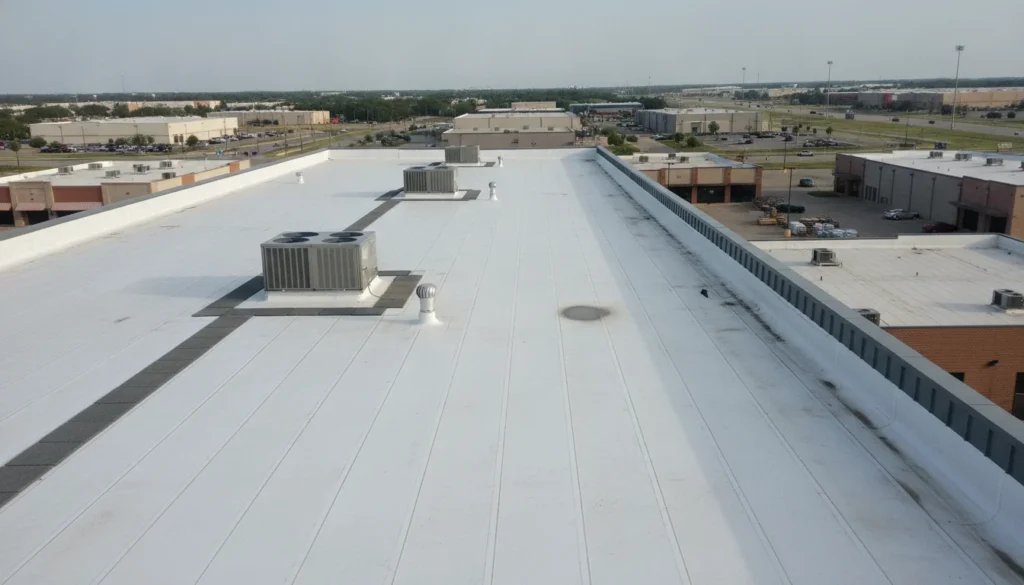
PVC is the membrane that shrugs off grease and chemicals, which is why Grandview restaurants and food-service buildings specify it over everything else.
Kitchen exhaust is brutal to most membranes; PVC is formulated to resist the oils and fats that degrade TPO and EPDM around vents. Heat-welded seams, strong reflectivity, and chemical resistance make PVC the specification wherever a Grandview roof lives downstream of a grease stack: restaurants, groceries, food processing.
We install and service pvc roofing across Grandview and the surrounding DFW communities. Expect free written estimates, documented inspections, and honest guidance on whether this system actually fits your building and budget.
Grandview’s hail record and commercial roof systems
With hail in Grandview reaching 2 inches on April 9, 2021 and no tennis-ball size or larger reports since 2006, owners can give heat, drainage, maintenance access and service life real weight alongside impact when choosing among membranes, built-up and modified bitumen systems, coatings and metal. Smaller hail, like the 1.25-inch storm on March 8, 2025, still wears on surfaces and seams. Grandview owners who want a clear picture can have Cedar Crest photograph the roof and write up a maintenance plan before the next storm, so upkeep is planned rather than reactive.
THE SYSTEM
PVC Roofing, up close.
PVC membrane. Welded single-ply built for chemical and grease resistance on demanding roofs.
PUBLIC RECORD
The local record behind PVC Roofing in Grandview
How a roof system holds up in Grandview depends on the storms it has to take and the houses it sits on. Here is what the public record shows.
8
Hail days, 1 in.+ since 2006
1
Golf-ball-size hail days
2 in.
Largest stone on record
1979
Median year homes built
Hail near Grandview
Reported hail is less frequent around Grandview: NOAA lists 8 days since 2006 with hail one inch or larger within 4 miles. Fewer reports can also reflect fewer storm spotters in smaller communities, so a quiet record is not a guarantee. Hail one inch or larger was reported in 5 of the last 20 years. The largest stones on record nearby measured 2 inches (hen egg size) on April 9, 2021. The most recent report: 1-inch hail on April 28, 2026.
April 9, 2021: 2-inch hail (hen egg size)
March 8, 2025: 1.25-inch hail (half dollar size)
April 28, 2026: 1-inch hail (quarter size)
June 1, 2025: 1-inch hail (quarter size)
November 4, 2024: 1-inch hail (quarter size)
How old Grandview homes are
The median home in Grandview was built in 1979, and 52% of the city's 812 housing units predate 1980. Many of these houses are likely on their second roof or nearing the point where they need one.
Sources: NOAA National Centers for Environmental Information, Storm Events Database (hail reports since 2006 within 4 miles of Grandview); U.S. Census Bureau, American Community Survey 2020–2024 5-year estimates. Data pulled September 2026.
Common questions about pvc roofing in Grandview
Why does my restaurant roof in Grandview need PVC specifically?
Grease resistance. Kitchen exhaust deposits oils that degrade other membranes around the vents. PVC is formulated for that exposure, which is why food-service specifications call for it.
Is PVC worth it on a non-restaurant building?
Sometimes. Its chemical resistance and seam strength are real. Without grease or chemical exposure, TPO usually delivers similar performance at friendlier cost.
Do you install this on shops and outbuildings near Grandview?
Yes. Barns, workshops, and outbuildings are first-class projects out here, not afterthoughts, and the material conversation (usually metal-forward) covers them alongside the house.
How often does hail hit Grandview?
NOAA lists 8 days since 2006 with hail one inch or larger within 4 miles of Grandview. Smaller communities have fewer storm spotters, so reports tend to undercount what actually falls. The most recent report was 1-inch hail on April 28, 2026.
How old are most homes in Grandview?
The median home in Grandview was built in 1979, according to the U.S. Census Bureau's American Community Survey. 52% of the city's housing units predate 1980 and 16% were built in 2010 or later. Most homes here are well past the life of their original roof.