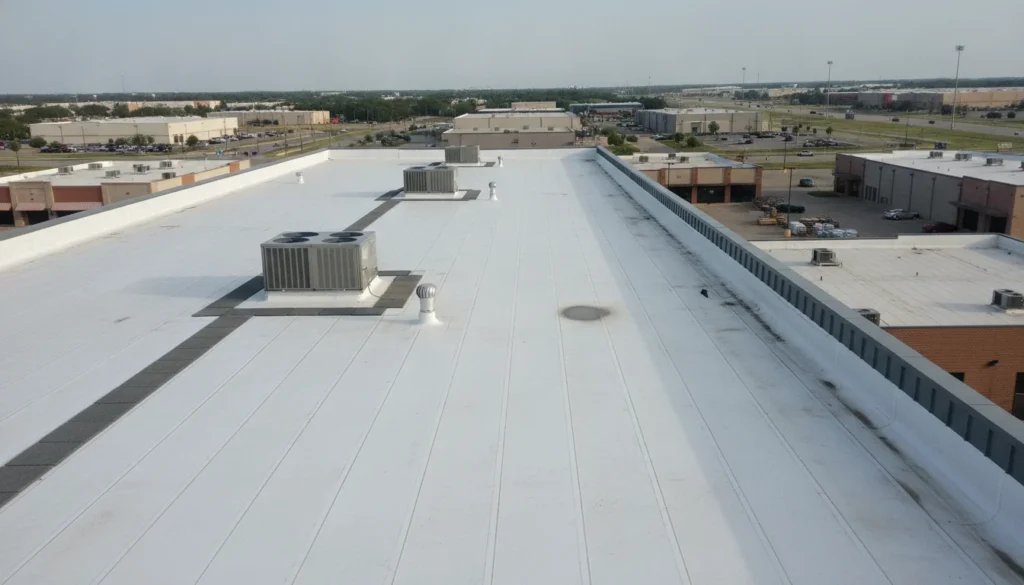
PVC is the membrane that shrugs off grease and chemicals, which is why Lucas restaurants and food-service buildings specify it over everything else.
Kitchen exhaust is brutal to most membranes; PVC is formulated to resist the oils and fats that degrade TPO and EPDM around vents. Heat-welded seams, strong reflectivity, and chemical resistance make PVC the specification wherever a Lucas roof lives downstream of a grease stack: restaurants, groceries, food processing.
We install and service pvc roofing across Lucas and the surrounding DFW communities. Expect free written estimates, documented inspections, and honest guidance on whether this system actually fits your building and budget.
Commercial Roof Systems and Hail Risk in Lucas
A 3.25-inch stone on June 13, 2012 and a 2.75-inch stone on May 28, 2024 are part of the hail record within 5 miles of Lucas. Those sizes are a useful test when you compare membranes, coatings and metal for a commercial building, since each system handles impact, ponding and repair differently. No system is immune, so plan for routine inspections, especially after any storm with hail one inch or larger. Cedar Crest notes punctures, dents, split seams and coating loss with photos, giving owners and insurers a clear picture of the system’s condition.
THE SYSTEM
PVC Roofing, up close.
PVC membrane. Welded single-ply built for chemical and grease resistance on demanding roofs.
PUBLIC RECORD
The local record behind PVC Roofing in Lucas
How a roof system holds up in Lucas depends on the storms it has to take and the houses it sits on. Here is what the public record shows.
19
Hail days, 1 in.+ since 2006
7
Golf-ball-size hail days
3.25 in.
Largest stone on record
2005
Median year homes built
Hail near Lucas
NOAA's Storm Events Database lists 19 days since 2006 with hail one inch or larger reported within 5 miles of Lucas. On 7 of those days, the stones were golf ball size or bigger. Hail one inch or larger was reported in 11 of the last 20 years. The largest stones on record nearby measured 3.25 inches (teacup size) on June 13, 2012. The most recent report: 1.25-inch hail on April 27, 2026.
June 13, 2012: 3.25-inch hail (teacup size)
May 28, 2024: 2.75-inch hail (baseball size)
May 19, 2023: 2.5-inch hail (tennis ball size)
March 25, 2025: 2.25-inch hail (hen egg size)
April 20, 2023: 2-inch hail (hen egg size)
How old Lucas homes are
The median home in Lucas was built in 2005. A large share of the city's 2,856 housing units are now old enough that original roofs are coming due, while 35% were built in 2010 or later.
Sources: NOAA National Centers for Environmental Information, Storm Events Database (hail reports since 2006 within 5 miles of Lucas); U.S. Census Bureau, American Community Survey 2020–2024 5-year estimates. Data pulled September 2026.
Common questions about pvc roofing in Lucas
Why does my restaurant roof in Lucas need PVC specifically?
Grease resistance. Kitchen exhaust deposits oils that degrade other membranes around the vents. PVC is formulated for that exposure, which is why food-service specifications call for it.
Is PVC worth it on a non-restaurant building?
Sometimes. Its chemical resistance and seam strength are real. Without grease or chemical exposure, TPO usually delivers similar performance at friendlier cost.
Can you match the premium materials common in Lucas?
That's our premium catalog's home turf: tile, standing seam, stone-coated steel, and composite slate and shake, installed to manufacturer specification with the documentation the home's value deserves.
How often does hail hit Lucas?
NOAA's Storm Events Database lists 19 days since 2006 with hail one inch or larger reported within 5 miles of Lucas, including 7 days with golf ball size stones or bigger. Hail one inch or larger was reported in 11 of the last 20 years. The most recent report was 1.25-inch hail on April 27, 2026.
How old are most homes in Lucas?
The median home in Lucas was built in 2005, according to the U.S. Census Bureau's American Community Survey. 11% of the city's housing units predate 1980 and 35% were built in 2010 or later. Many homes here are reaching the age when original roofs come due.