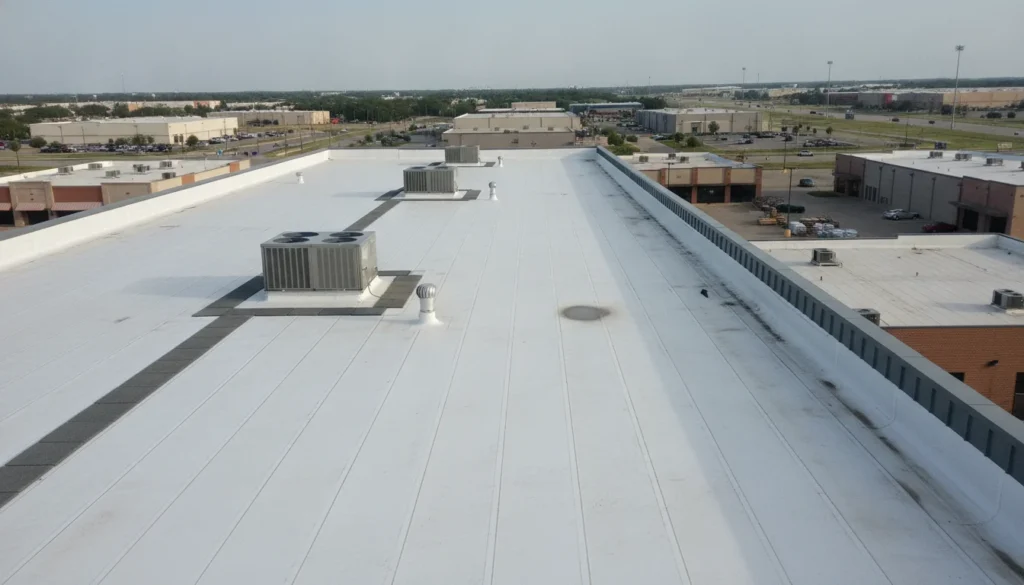
TPO is the dominant single-ply membrane on Lowry Crossing commercial roofs. It is white, reflective, heat-welded at the seams, and the economic default for most new low-slope work.
TPO earned its market share honestly: reflective white surface that fights Texas cooling loads, heat-welded seams stronger than the sheet itself when done right, and installed economics that beat most alternatives. The membrane’s reputation variance in Lowry Crossing is mostly a workmanship story. Seam quality is everything, which makes installer selection the real specification.
We install and service tpo roofing across Lowry Crossing and the surrounding DFW communities. You get free written estimates, documented inspections, and honest guidance on whether this system actually fits your home and budget.
On the ground in Lowry Crossing
What TPO Roofing costs and returns in Lowry Crossing depends on the houses it goes onto. The ring towns mix housing eras freely: a 1970s ranch, a 1990s two-story, and a this-year build can share one street, and each takes this system differently. That inventory rewards the boring commercial virtues: documented seams, maintained drains, and a membrane matched to the building’s actual use.
The permit runs through Lowry Crossing’s building department; we handle the filing and the inspection scheduling as part of the job. When the next core drops through Collin County, single-ply shows bruise fractures that a chalk circle will not catch. Instrument surveys find what walking the roof misses. Because Plano, Frisco, and McKinney share our dispatch routes, examples of this exact system nearby are easy to arrange. We put the whole thing in writing (findings, grade, price, warranty) before you commit to anything.
THE SYSTEM
TPO Roofing, up close.
TPO membrane. White single-ply with heat-welded seams and flashed curbs, managed as a system.
PUBLIC RECORD
The local record behind TPO Roofing in Lowry Crossing
How a roof system holds up in Lowry Crossing depends on the storms it has to take and the houses it sits on. Here is what the public record shows.
10
Hail days, 1 in.+ since 2006
2
Golf-ball-size hail days
2.75 in.
Largest stone on record
1994
Median year homes built
Hail near Lowry Crossing
Reported hail is less frequent around Lowry Crossing: NOAA lists 10 days since 2006 with hail one inch or larger within 4 miles. Fewer reports can also reflect fewer storm spotters in smaller communities, so a quiet record is not a guarantee. Hail that size was reported in 9 of the last 20 years. The largest stones on record nearby measured 2.75 inches (baseball size) on May 28, 2024. The most recent report: 1.25-inch hail on March 25, 2025.
May 28, 2024: 2.75-inch hail (baseball size)
June 15, 2023: 1.75-inch hail (golf ball size)
March 14, 2022: 1.5-inch hail (walnut size)
June 6, 2018: 1.5-inch hail (walnut size)
March 17, 2016: 1.5-inch hail (walnut size)
How old Lowry Crossing homes are
The median home in Lowry Crossing was built in 1994, and 13% of the city's 498 housing units predate 1980. Many of these houses are likely on their second roof or nearing the point where they need one.
Sources: NOAA National Centers for Environmental Information, Storm Events Database (hail reports since 2006 within 4 miles of Lowry Crossing); U.S. Census Bureau, American Community Survey 2020–2024 5-year estimates. Data pulled September 2026.
Common questions about tpo roofing in Lowry Crossing
Why is TPO so common on Lowry Crossing commercial buildings?
Economics plus reflectivity: white TPO reflects Texas sun and cuts cooling loads, and installed cost per square beats most alternatives. Seam workmanship separates good TPO roofs from problem ones.
What thickness TPO should I specify?
Sixty-mil is the common commercial baseline; forty-five suits budget-driven jobs and eighty adds puncture margin under heavy rooftop traffic. Thickness buys durability, so match it to the building's use.
Do you install this on shops and outbuildings near Lowry Crossing?
Yes. Barns, workshops, and outbuildings are first-class projects out here, not afterthoughts, and the material conversation (usually metal-forward) covers them alongside the house.
How often does hail hit Lowry Crossing?
NOAA lists 10 days since 2006 with hail one inch or larger within 4 miles of Lowry Crossing. Smaller communities have fewer storm spotters, so reports tend to undercount what actually falls. The most recent report was 1.25-inch hail on March 25, 2025.
How old are most homes in Lowry Crossing?
The median home in Lowry Crossing was built in 1994, according to the U.S. Census Bureau's American Community Survey. 13% of the city's housing units predate 1980 and 4% were built in 2010 or later. Many homes here are reaching the age when original roofs come due.