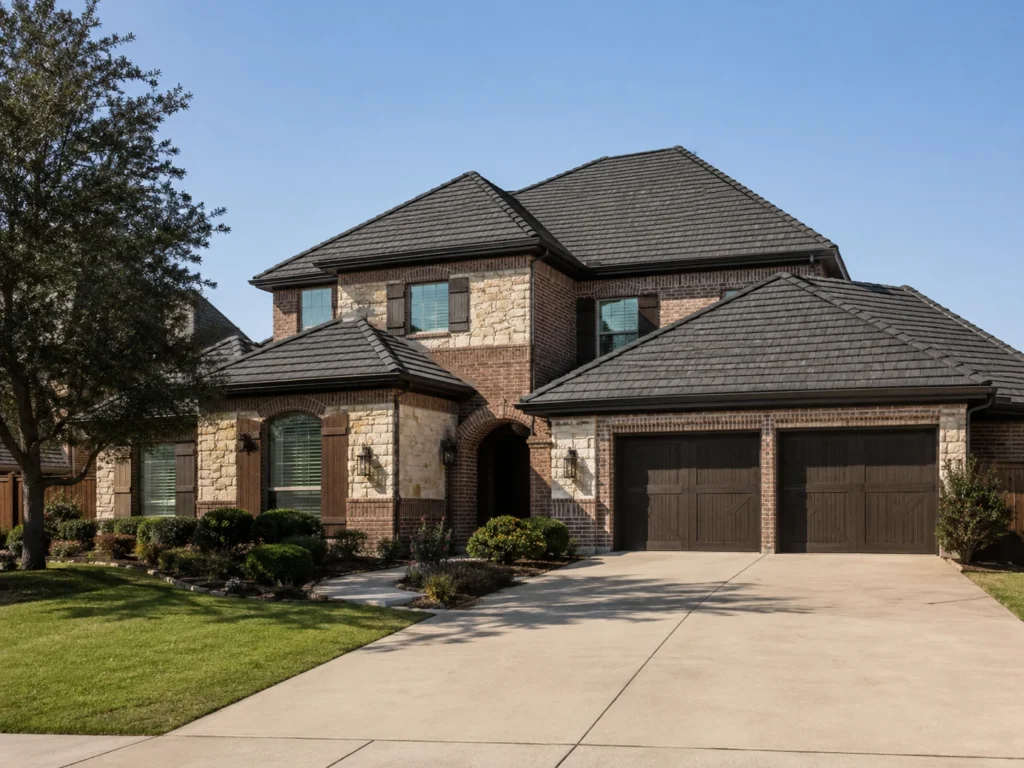
Synthetic slate and shake systems reproduce premium roof aesthetics in engineered polymer that is lighter than the natural materials they emulate, with impact ratings suited to Cockrell Hill hail country.
The synthetic category exists because slate’s weight and cedar’s maintenance stop many Cockrell Hill homeowners who love those looks. Engineered polymer tiles solve both: a fraction of slate’s weight, none of cedar’s feeding schedule, and Class 4 impact ratings across most product lines. The honest trade is authenticity up close and a shorter track record than the centuries-old materials they mimic.
We install and service composite / synthetic roofing across Cockrell Hill and the surrounding DFW communities. Expect free written estimates, documented inspections, and honest guidance on whether this system actually fits your home and budget.
How Cockrell Hill changes the math
Composite / Synthetic Roofing behaves differently on Cockrell Hill roofs than the brochure version suggests. Much of the housing here has already been through a roof cycle or two: mature trees, settled framing, and decking that has absorbed decades of North Texas heat. Polymer shake and slate fit that stock where owners want the look without the maintenance contract. They are Class 4 rated, fire rated, and indifferent to the treatment cycle wood demands.
Permit-wise, this work in Cockrell Hill runs through the city’s building department. The filing is our job, not yours. Hail is the tax every DFW roof eventually pays. Polymer profiles rebound where wood splits and brittle materials crack; that is what the Class 4 rating is for. We work this system in Dallas and Irving as well. Ask and we will point you at nearby examples with a few years of weather on them. The next step costs nothing: a documented inspection and a straight answer on whether this system fits.
THE SYSTEM
Composite / Synthetic Roofing, up close.
Composite / synthetic. The architecture of slate or shake with Class 4 ratings and no upkeep cycle.
PUBLIC RECORD
The local record behind Composite / Synthetic Roofing in Cockrell Hill
How a roof system holds up in Cockrell Hill depends on the storms it has to take and the houses it sits on. Here is what the public record shows.
6
Hail days, 1 in.+ since 2006
3
Golf-ball-size hail days
2 in.
Largest stone on record
1954
Median year homes built
Hail near Cockrell Hill
Reported hail is less frequent around Cockrell Hill: NOAA lists 6 days since 2006 with hail one inch or larger within 4 miles. Fewer reports can also reflect fewer storm spotters in smaller communities, so a quiet record is not a guarantee. Hail that size was reported in 4 of the last 20 years. The largest stones on record nearby measured 2 inches (hen egg size) on April 9, 2021. The most recent report: 1.5-inch hail on April 26, 2026.
April 9, 2021: 2-inch hail (hen egg size)
May 27, 2024: 1.75-inch hail (golf ball size)
May 20, 2010: 1.75-inch hail (golf ball size)
April 26, 2026: 1.5-inch hail (walnut size)
June 13, 2023: 1.5-inch hail (walnut size)
How old Cockrell Hill homes are
Half of Cockrell Hill's 1,329 housing units were built in 1954 or earlier, and 88% predate 1980. On homes that age, today's roof is rarely the original, and older decking, layered repairs and ventilation that was never brought up to date are common.
Sources: NOAA National Centers for Environmental Information, Storm Events Database (hail reports since 2006 within 4 miles of Cockrell Hill); U.S. Census Bureau, American Community Survey 2020–2024 5-year estimates. Data pulled September 2026.
Common questions about composite / synthetic roofing in Cockrell Hill
Do synthetic roofs look fake in Cockrell Hill?
From the street, good synthetics read convincingly as slate or shake, because molds are cast from natural materials. Up close the uniformity shows; most owners consider it a fair trade for weight and hail performance.
How do synthetics handle DFW hail?
Most quality lines carry Class 4 impact ratings, and the polymer flexes where slate cracks and cedar splits. It is one of the category's strongest arguments in Cockrell Hill.
Should we match the original material when re-roofing in Cockrell Hill?
Not automatically. A roof on its second or third cycle is a chance to rethink: Class 4 asphalt for the insurance math, metal or premium systems where the home and horizon justify them. We quote the honest options against your actual house.
How often does hail hit Cockrell Hill?
NOAA lists 6 days since 2006 with hail one inch or larger within 4 miles of Cockrell Hill. Smaller communities have fewer storm spotters, so reports tend to undercount what actually falls. The most recent report was 1.5-inch hail on April 26, 2026.
How old are most homes in Cockrell Hill?
The median home in Cockrell Hill was built in 1954, according to the U.S. Census Bureau's American Community Survey. 88% of the city's housing units predate 1980 and 5% were built in 2010 or later. Most homes here are well past the life of their original roof.