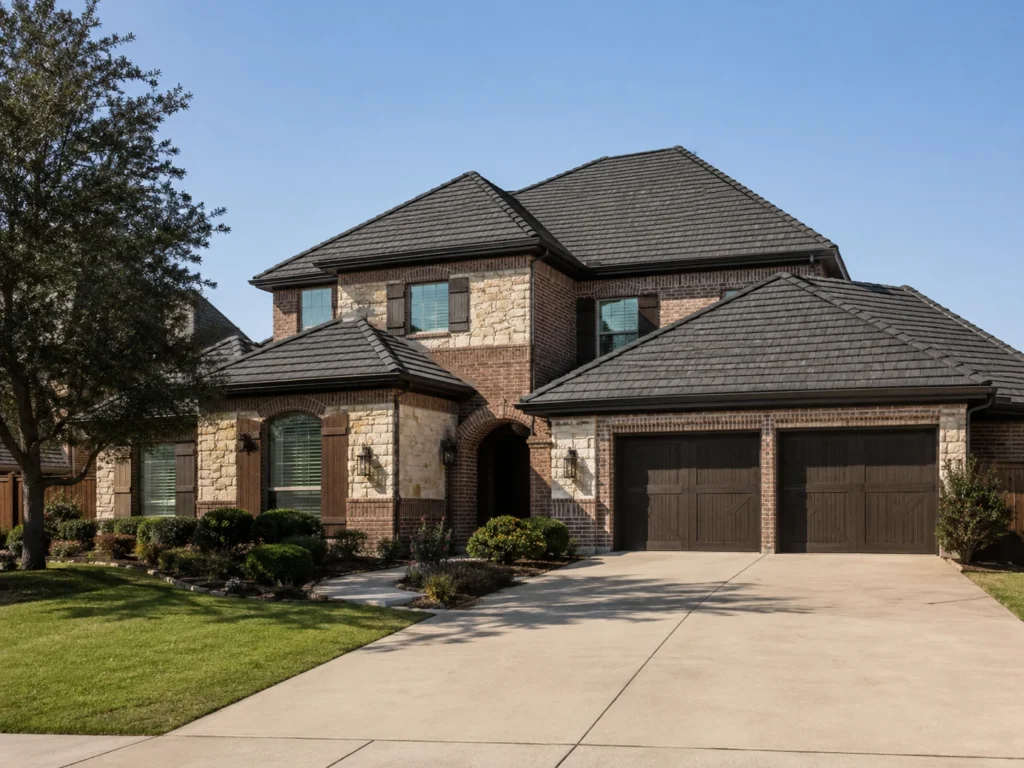
Synthetic slate and shake systems reproduce premium roof aesthetics in engineered polymer that is lighter than the natural materials they emulate, with impact ratings suited to Mabank hail country.
The synthetic category exists because slate’s weight and cedar’s maintenance stop many Mabank homeowners who love those looks. Engineered polymer tiles solve both: a fraction of slate’s weight, none of cedar’s feeding schedule, and Class 4 impact ratings across most product lines. The honest trade is authenticity up close and a shorter track record than the centuries-old materials they mimic.
We install and service composite / synthetic roofing across Mabank and the surrounding DFW communities. Expect free written estimates, documented inspections, and honest guidance on whether this system actually fits your home and budget.
On the ground in Mabank
In Mabank, the Composite / Synthetic Roofing conversation usually starts with the roof that is already up there. Housing this far out is less uniform than the inner suburbs. Age, pitch, and construction quality vary house to house, so the material fit does too. On those houses, composite is the pragmatic route to a premium roofline: molded from real profiles, rated for the hail belt, and done with the upkeep argument.
City paperwork in Mabank is ours to carry: permit filed, inspection booked, final documentation in your folder. North Texas sits in the country’s most active hail belt, and polymer profiles rebound where wood splits and brittle materials crack. That is what the Class 4 rating is for. Crews rotate through Kaufman, Terrell, and Forney on the same routes, which keeps Mabank scheduling flexible. Once we have looked at the actual roof, everything above gets specific and goes in writing.
THE SYSTEM
Composite / Synthetic Roofing, up close.
Composite / synthetic. The architecture of slate or shake with Class 4 ratings and no upkeep cycle.
PUBLIC RECORD
The local record behind Composite / Synthetic Roofing in Mabank
How a roof system holds up in Mabank depends on the storms it has to take and the houses it sits on. Here is what the public record shows.
7
Hail days, 1 in.+ since 2006
1
Golf-ball-size hail days
1.75 in.
Largest stone on record
2002
Median year homes built
Hail near Mabank
Reported hail is less frequent around Mabank: NOAA lists 7 days since 2006 with hail one inch or larger within 5 miles. Fewer reports can also reflect fewer storm spotters in smaller communities, so a quiet record is not a guarantee. Hail that size was reported in 4 of the last 20 years. The largest stones on record nearby measured 1.75 inches (golf ball size) on April 18, 2015. The most recent report: 1-inch hail on April 29, 2026.
April 18, 2015: 1.75-inch hail (golf ball size)
March 24, 2021: 1.5-inch hail (walnut size)
January 25, 2021: 1.25-inch hail (half dollar size)
May 3, 2017: 1.25-inch hail (half dollar size)
April 29, 2026: 1-inch hail (quarter size)
How old Mabank homes are
The median home in Mabank was built in 2002. A large share of the city's 1,940 housing units are now old enough that original roofs are coming due, while 32% were built in 2010 or later.
Sources: NOAA National Centers for Environmental Information, Storm Events Database (hail reports since 2006 within 5 miles of Mabank); U.S. Census Bureau, American Community Survey 2020–2024 5-year estimates. Data pulled September 2026.
Common questions about composite / synthetic roofing in Mabank
Do synthetic roofs look fake in Mabank?
From the street, good synthetics read convincingly as slate or shake, because molds are cast from natural materials. Up close the uniformity shows; most owners consider it a fair trade for weight and hail performance.
How do synthetics handle DFW hail?
Most quality lines carry Class 4 impact ratings, and the polymer flexes where slate cracks and cedar splits. It is one of the category's strongest arguments in Mabank.
Do you install this on shops and outbuildings near Mabank?
Yes. Barns, workshops, and outbuildings are first-class projects out here, not afterthoughts, and the material conversation (usually metal-forward) covers them alongside the house.
How often does hail hit Mabank?
NOAA lists 7 days since 2006 with hail one inch or larger within 5 miles of Mabank. Smaller communities have fewer storm spotters, so reports tend to undercount what actually falls. The most recent report was 1-inch hail on April 29, 2026.
How old are most homes in Mabank?
The median home in Mabank was built in 2002, according to the U.S. Census Bureau's American Community Survey. 27% of the city's housing units predate 1980 and 32% were built in 2010 or later. Many homes here are reaching the age when original roofs come due.